
Risk Premium Guide: Understanding Value in 2026
Imagine facing the investment landscape of 2026, where uncertainty and opportunity appear side by side. How do you measure value with so many unknowns? Understanding risk premium is essential for making informed decisions and evaluating potential returns.
This guide will give you the tools to identify, calculate, and use risk premium in your financial strategy. You will learn the core concepts, see calculation methods, and explore real-world trends and examples. Let this be your roadmap to smarter, data-driven investing in a changing world.
What Is Risk Premium? Foundations and Definitions
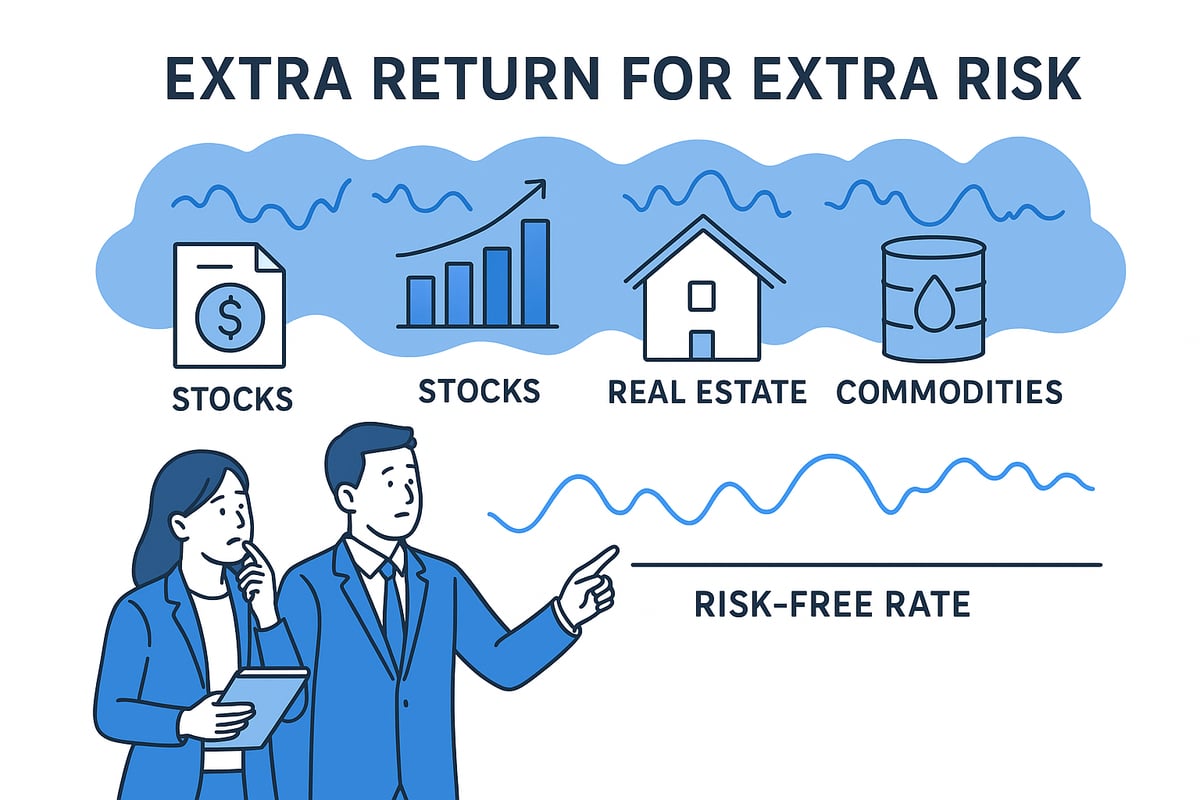
Understanding the risk premium is fundamental for anyone aiming to make informed investment decisions in 2026. At its core, the risk premium represents the additional return investors expect for choosing a risky asset over a risk-free one. This concept is crucial because it helps investors weigh the trade-off between risk and reward in every financial decision.
Core Concept and Formal Definition
The risk premium is defined as the extra return demanded by investors for taking on risk beyond what is offered by a risk-free asset. A risk-free rate is typically represented by government securities, such as US Treasury bonds, which are considered nearly default-proof. According to expected utility theory, the risk premium acts as compensation for the uncertainty and potential loss associated with risky assets.
It is important to distinguish the risk premium from related terms. While the required return reflects the minimum acceptable yield for an investor, and the expected return is what an investor anticipates earning, the risk premium specifically measures the difference between the expected return and the risk-free rate. For example, if a 10-year Treasury yields 2 percent and a stock is expected to yield 7 percent, the risk premium is 5 percent.
A helpful analogy is to think of the risk premium as extra credit earned for taking a more challenging course. This premium is not fixed; it changes with market conditions, economic cycles, and investor sentiment, making it a dynamic and context-dependent measure.
Types of Risk Premiums
Risk premiums manifest in different forms across asset classes. The equity risk premium refers to the additional return required for investing in stocks over risk-free assets. The debt risk premium is the extra yield that lenders demand for lending to riskier borrowers. The market risk premium aggregates the extra compensation investors require for holding the entire market compared to risk-free securities.
Other types include premiums in real estate, commodities, and alternative investments, each reflecting their unique risk profiles. For instance, the historical average equity risk premium for the S&P 500 over the past 25 years has been about 5.94 percent. To better evaluate and compare these risk premiums, investors often consider concepts like risk-weighted assets, which help quantify the level of risk associated with different investments.
| Asset Class | Typical Risk Premium | Risk Factors |
|---|---|---|
| Equities | ~5-6% | Market, growth |
| Bonds | 1-3% above gov't | Default, credit |
| Real Estate | 3-5% | Illiquidity, cycles |
| Commodities | Variable | Supply, demand |
Each asset class carries its own risk characteristics and corresponding premium.
Why Risk Premium Exists
The existence of a risk premium is rooted in investor psychology and the realities of financial markets. Investors require compensation for facing uncertainty and the possibility of loss. When market volatility rises, during economic downturns or geopolitical crises, risk premiums tend to increase as investors become more cautious.
Behavioral finance also plays a role. People are naturally risk-averse, and their perceptions of uncertainty influence the risk premium they demand. For example, between 1963 and 1983, US stocks experienced negative risk premiums, meaning risky assets underperformed risk-free ones. This variability highlights that the risk premium is influenced by both rational factors—such as data and probability—and emotional responses to risk.
Ultimately, understanding the risk premium equips investors with a lens to assess value, navigate uncertainty, and make more informed decisions in a changing financial landscape.
How to Calculate and Interpret Risk Premiums
Understanding how to calculate and interpret risk premium is crucial for any investor aiming to make data-driven decisions. This section breaks down the process, explores influential factors, and guides you through reading risk premium signals in today's markets.
Step-by-Step Calculation Methods
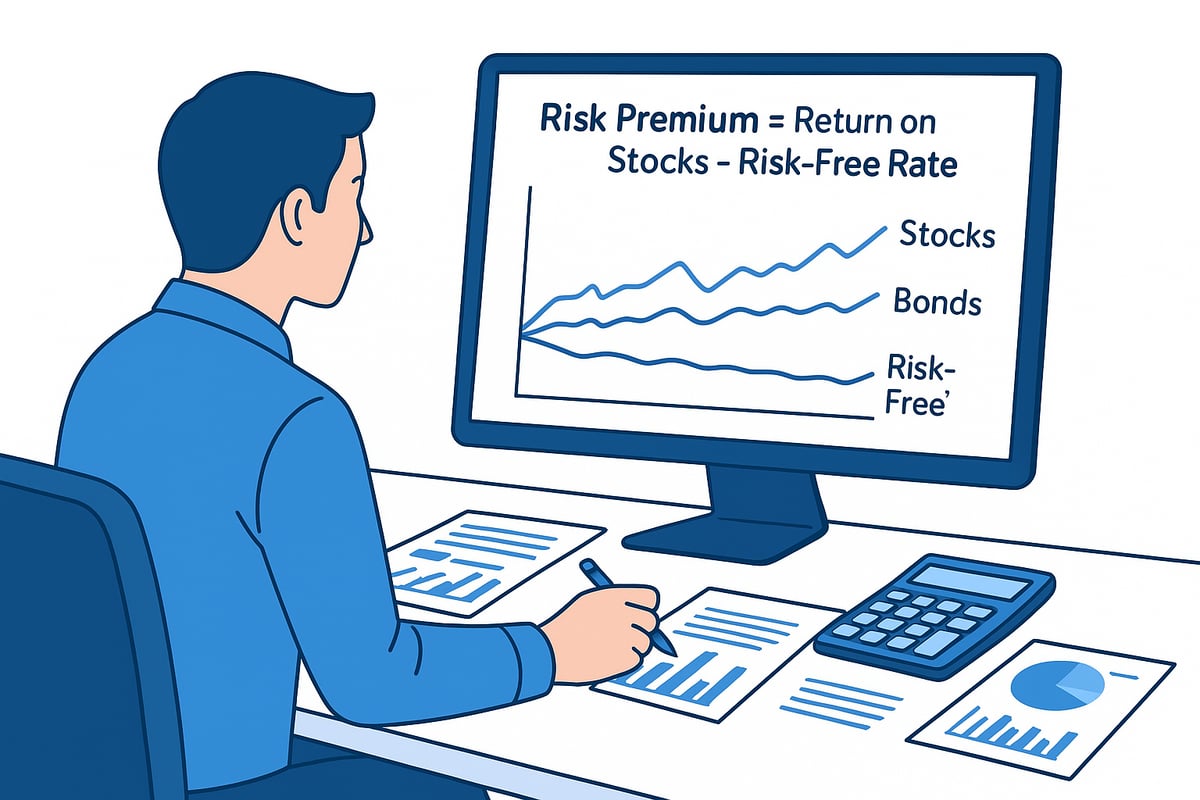
Calculating risk premium starts with a simple formula:
Risk Premium = Rate of Return – Risk-Free Rate of Return
Typically, the risk-free rate is represented by the yield on government securities such as 10-year Treasury bonds. To determine the risk premium, subtract this benchmark from the expected or historical return of an asset. For example, if a stock has an expected return of 8% and the Treasury yield is 2.25%, the risk premium is 5.75%.
When estimating risk premium, investors often use data from sources like the S&P 500 for equity returns or corporate bond yields for credit risk. There are different approaches:
- Historical risk premium: Based on past returns.
- Current risk premium: Uses recent data.
- Implied risk premium: Forward-looking, derived from market prices, expected cash flows, and discount rates.
Each method has its challenges. Estimating the expected return and choosing the correct risk-free rate can introduce uncertainty, especially in volatile periods. Remember, risk premium calculations are only as accurate as the assumptions and data used.
Factors Influencing Risk Premiums
Several factors can cause risk premium to fluctuate over time. The macroeconomic environment plays a significant role. Changes in inflation, interest rates, and economic growth expectations directly impact risk premiums. When markets become more volatile or uncertain, investors typically demand a higher risk premium to compensate for added risk.
Investor sentiment is another driver. In bull markets, optimism can compress risk premium, while bear markets or geopolitical tensions increase it. Policy and regulatory changes, such as new financial regulations or central bank actions, also shape risk perceptions.
For example, during the market volatility of 2020, the average market risk premium surged to around 5.6%. Recent analysis of Declining Risk Premiums in Equity and Credit Markets shows how macro trends and shifting investor attitudes can drive notable changes in risk premium across asset classes.
Understanding these factors helps investors better anticipate shifts and adapt their strategies accordingly.
Interpreting High, Low, and Negative Risk Premiums
Interpreting risk premium levels is essential for building resilient portfolios. A high risk premium signals elevated uncertainty or perceived risk in the market. This might indicate that investors are wary, expecting potential losses or turbulence. In contrast, a low risk premium suggests market confidence, stability, or possibly complacency.
Occasionally, risk premium can turn negative. This happens when risky assets underperform risk-free assets, as seen in the US stock market from 1963 to 1983. Negative risk premium periods challenge traditional asset allocation strategies and may prompt a shift toward safer investments.
For investors, monitoring risk premium trends aids in making informed asset allocation decisions. Adjusting exposure based on whether the risk premium is high, low, or negative can help optimize returns while managing risk.
The Role of Risk Premium in Investment and Valuation
Understanding the risk premium is fundamental for any investor aiming to make informed decisions. It is not just a theoretical concept but a practical tool that shapes how portfolios are constructed, assets are priced, and businesses are valued.
Risk Premium in Portfolio Theory and Asset Pricing
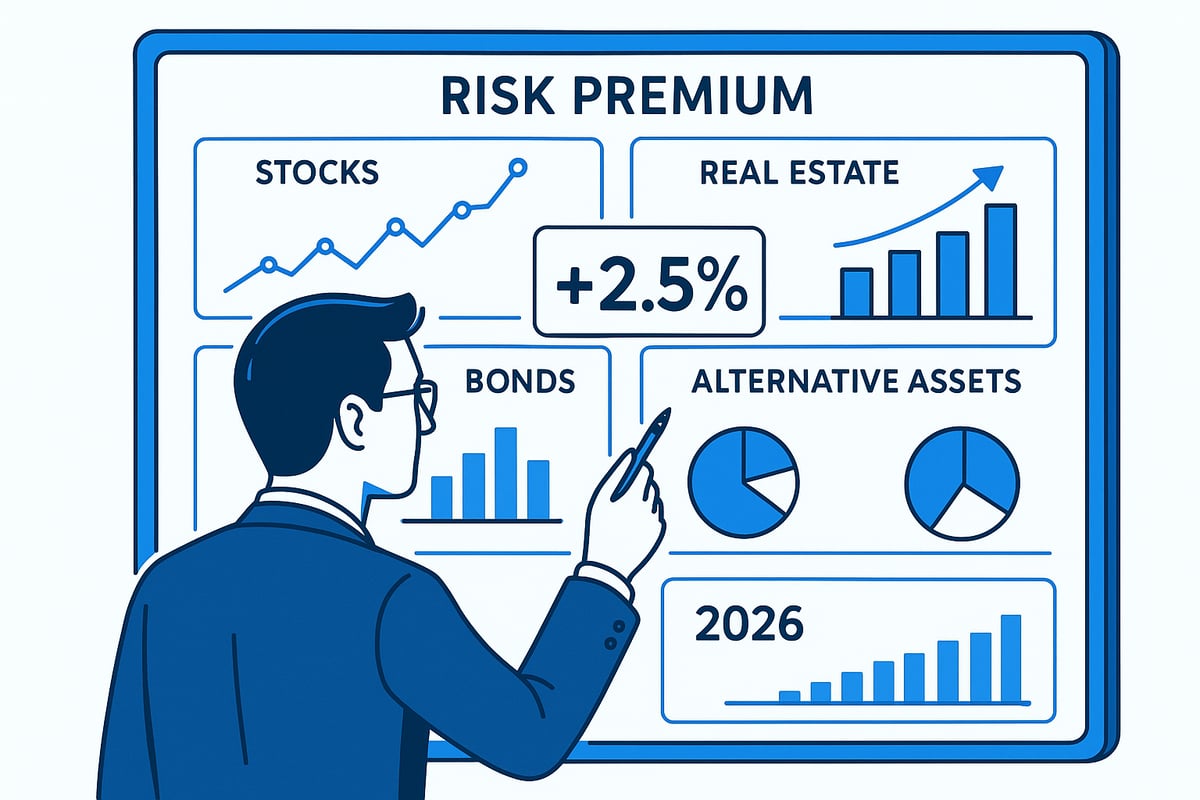
The risk premium is central to modern portfolio theory (MPT). MPT emphasizes balancing risk and reward, and the risk premium quantifies the extra return needed to justify taking on riskier assets. In practical terms, the Capital Asset Pricing Model (CAPM) uses the risk premium to estimate a security’s expected return. The formula is: Expected Return = Risk-Free Rate + Beta × Market Risk Premium. This calculation helps investors determine if a security is undervalued or overvalued in relation to its risk.
The Security Market Line (SML) is a visual tool that shows the relationship between risk and expected return. Assets above the SML may be undervalued, while those below could be overpriced. The efficient market hypothesis also connects closely to risk premium, suggesting that all known risks are quickly reflected in asset prices. For more on this, see What is the efficient market hypothesis.
Understanding these models allows investors to assess if the compensation for risk is adequate. The risk premium, therefore, is not static but adapts to changing market conditions.
Application Across Asset Classes
The risk premium varies significantly by asset class. In equities, the equity risk premium reflects the extra return investors expect for holding stocks over government bonds. For bonds, credit spreads serve as the risk premium for lending to borrowers with different credit ratings. Real estate and alternatives offer premiums for illiquidity and unique risks, while commodities' risk premiums shift with supply and demand shocks.
Here’s a summary:
| Asset Class | Typical Risk Premium | Key Risks |
|---|---|---|
| Equities | 5–7% | Market, business |
| Corporate Bonds | 1–4% | Credit, default |
| Real Estate | 3–6% | Illiquidity, market cycles |
| Commodities | 2–5% | Price volatility, demand/supply |
Each asset class carries its own risk premium profile, allowing investors to diversify and tailor their portfolios based on risk tolerance and return goals.
Risk Premium in Business Valuation
Business valuation relies heavily on the risk premium to determine discount rates. In discounted cash flow (DCF) analysis, the discount rate includes the risk-free rate plus a risk premium reflecting the uncertainty of future cash flows. A higher risk premium increases the discount rate, reducing the present value of projected earnings.
The implied risk premium is often used for forward-looking valuations, adjusting for current market conditions and future expectations. Cost of capital and hurdle rates for projects are also influenced by the required risk premium. For example, tech startups typically have a higher risk premium than stable blue-chip companies due to greater uncertainty.
Accurately estimating the risk premium ensures that business valuations and investment decisions are grounded in realistic expectations.
Behavioral and Psychological Influences
Behavioral factors can significantly influence the risk premium demanded by investors. Herd behavior, overconfidence, and fluctuating risk perception often lead to shifts in market-wide premiums. During sudden market panics, the risk premium can spike as investors seek additional compensation for uncertainty.
Insights from behavioral finance show that these psychological influences can cause short-term mispricings. For instance, when investors collectively underestimate risk, the risk premium may fall, only to surge during periods of heightened fear.
Recognizing these patterns helps investors remain disciplined and avoid emotional decision-making, ensuring the risk premium is used wisely in portfolio management.
Real-World Examples and Case Studies: Risk Premium in Action
Understanding how the risk premium operates in real markets is essential for making informed investment decisions. By examining historical data, recent shifts, unusual cases, and sector-specific dynamics, investors can see how the risk premium shapes value and guides asset allocation.
Historical Market Risk Premiums
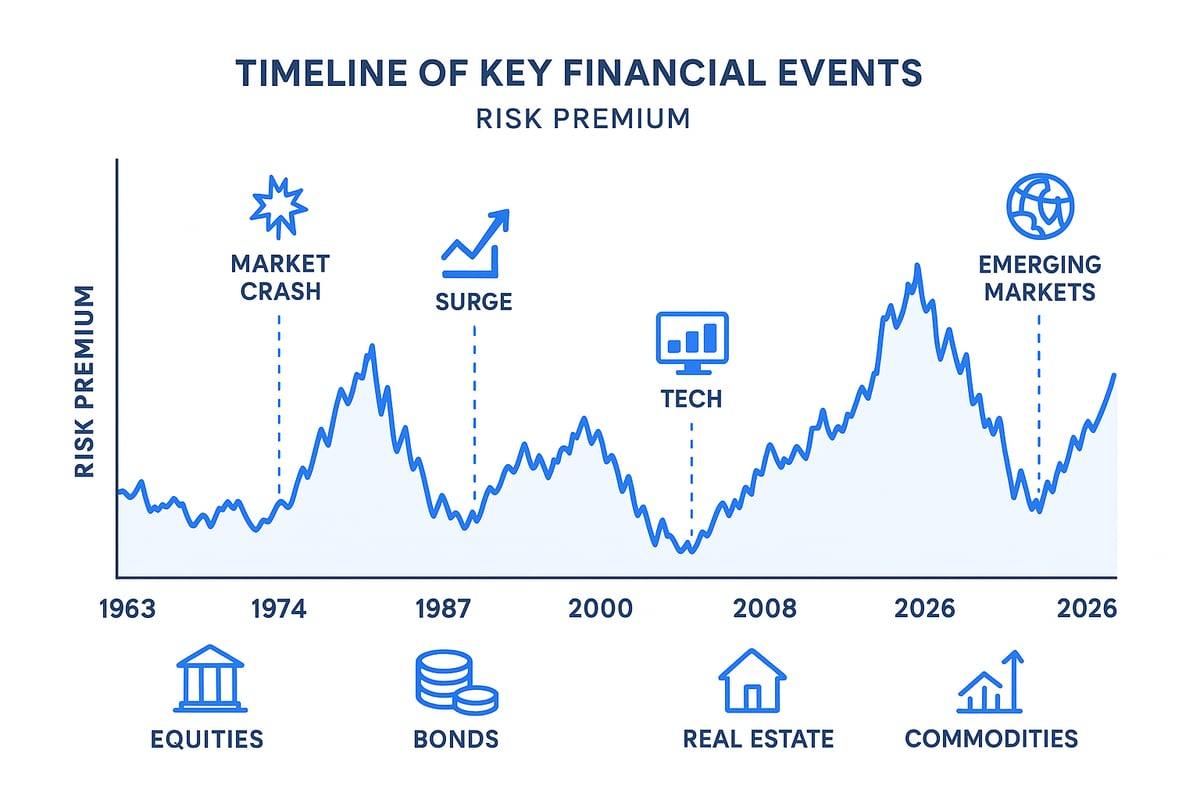
The concept of the risk premium is best illustrated through historical market data. For example, the S&P 500 has delivered an average historical risk premium of approximately 5.94% over the 25 years leading up to 2020, according to Robinhood. This figure highlights the extra return investors have received for holding stocks instead of risk-free assets like Treasury bonds.
Bond markets also provide a clear view of how the risk premium shifts over time. Credit spreads, which represent the additional yield investors demand for taking on corporate or lower-rated government debt, tend to widen during recessions. This reflects a higher risk premium and signals increased uncertainty about borrowers’ ability to repay.
Commodities present another dimension. When geopolitical crises hit, the risk premium for assets like oil and gold can spike, as investors seek compensation for unpredictable supply disruptions or inflationary risks. These historical patterns show that the risk premium is sensitive to global events and economic cycles.
Current and Recent Trends (2020–2026)
The years from 2020 to 2026 have seen dramatic changes in the risk premium across asset classes. During the COVID-19 pandemic, markets experienced extreme uncertainty. As a result, the average market risk premium surged to around 5.6%, reflecting heightened investor caution.
As economies began to recover, risk premium levels adjusted. From 2022 to 2025, rising interest rates and shifting inflation expectations led to further changes. Real estate markets, in particular, saw a higher risk premium due to increased volatility and concerns over commercial property demand.
Recent data suggest that investors are closely monitoring risk premium trends to adapt their strategies. This period highlights how quickly the risk premium can respond to new information, policy shifts, and broader macroeconomic forces. For investors, tracking the risk premium is crucial for portfolio management.
Negative and Unusual Risk Premiums
There have been rare periods when the risk premium turned negative. Between 1963 and 1983, US stocks underperformed risk-free assets, resulting in a negative risk premium. Such instances challenge conventional wisdom, as investors received less return for taking on greater risk.
Negative risk premium episodes often prompt a re-evaluation of diversification strategies. They remind investors that risk premium trends are not static and can deviate from historical norms. Being aware of these rare cases helps investors better manage expectations and avoid complacency.
Sector-Specific Examples
Different sectors and regions feature distinct risk premium profiles. Technology stocks generally command a higher risk premium due to rapid innovation and volatility, while utilities offer lower premiums, reflecting their stability. Emerging markets often exhibit elevated risk premiums because of political, economic, and currency risks.
Investors exploring opportunities abroad should consider country risk assessments, as these can significantly impact the equity risk premium. For deeper insights into how country-specific factors shape the risk premium, Professor Aswath Damodaran’s analysis in Country Risk 2025: The Story behind the Numbers is a valuable resource.
Startup investments present another example. Because of their unproven business models and uncertain outlook, startups require a much larger risk premium compared to established blue-chip companies.
Lessons Learned from Past Cycles
Historical cycles reveal that risk premium compression often occurs before financial crises. For instance, in the years leading up to the 2008 crisis, investors accepted lower risk premiums, underestimating potential dangers. After a crisis, risk premium levels are typically reassessed, leading to more cautious asset pricing.
These lessons underscore the importance of placing current risk premium data in context. Investors who understand the full cycle are better equipped to spot unsustainable trends and make informed decisions. Learning from past risk premium patterns is vital for maintaining a balanced and resilient portfolio.
Risk Premiums in 2026: Trends, Predictions, and Strategic Insights
The investment landscape in 2026 is shaped by rapid shifts in economics, technology, and geopolitics. Understanding the risk premium is more important than ever for investors aiming to navigate uncertainty and seize opportunities. In this section, we explore the major forces driving risk premium changes, asset class trends, investor perspectives, and actionable strategies for the year ahead.
Key Drivers of Risk Premiums in 2026
Several macro forces are set to influence risk premium levels in 2026. Interest rates remain a central factor, as central banks respond to inflation and economic growth. Global economic recovery post-pandemic continues to create both optimism and caution. Geopolitical tensions, including trade disputes and supply chain disruptions, are pushing investors to reevaluate risk. Technological innovation, especially in AI and fintech, is reshaping how risk is measured and priced. For a deeper look at these anticipated financial shifts and their effect on risk premium, see Financial Trends 2025: Prepare for a Roller-Coaster Ride.
Expected Changes Across Asset Classes
Each asset class will experience unique shifts in risk premium during 2026. In equities, some analysts expect premiums to revert closer to historical norms, though structural changes may persist. Bond markets are adjusting to higher rates, with credit spreads reflecting evolving default risks. Real estate investors are recalibrating for new risks such as remote work and climate impacts. Alternatives, including cryptocurrency and digital assets, are developing distinct risk premium profiles as markets mature. Understanding these shifts is crucial for effective portfolio allocation.
Institutional and Retail Investor Perspectives
Institutional investors like pension funds and endowments are reassessing their risk premium assumptions, often shifting more capital into alternatives for higher risk-adjusted returns. Retail investors, meanwhile, are becoming more sophisticated, using tools and data to monitor risk premium changes in real time. Both groups are adapting portfolio construction, with a greater emphasis on diversification and dynamic risk management. Shifts in risk tolerance and market participation are accelerating, reflecting a broader awareness of risk premium dynamics in 2026.
Practical Strategies for Investors
To manage changing risk premium landscapes, investors should consider several actionable strategies:
- Regularly review portfolio allocations
- Diversify across asset classes to buffer against shifts in risk premium
- Monitor both implied and observed premiums for timely tactical decisions
Using historical averages as a benchmark remains helpful, but integrating current data and forward-looking analysis is essential. Scenario analysis and stress-testing can reveal vulnerabilities in portfolios, enabling proactive adjustments as risk premium expectations evolve.
Risk Premium and Value Investing in the Modern Era
Value investors in 2026 must integrate risk premium analysis into their selection process. Identifying undervalued or overvalued assets requires understanding not just price-to-earnings or book value, but also how the risk premium reflects future uncertainty. Screening tools that incorporate risk premium metrics help pinpoint opportunities, while a forward-looking approach guards against overreliance on past data. In the modern era, adapting to new information and trends in risk premium is key to maintaining an edge in value investing.
Common Pitfalls and Advanced Considerations in Risk Premium Analysis
Understanding the risk premium is essential, but even experienced investors can fall into common traps. By recognizing frequent errors and exploring advanced techniques, you can sharpen your analysis and avoid costly misjudgments. Below, we break down pitfalls, sophisticated approaches, and best practices for evaluating risk premium in today’s complex markets.
Misconceptions and Errors
Misunderstanding the risk premium can lead to poor investment choices. One frequent error is confusing risk premium with total return or the risk-free rate. Investors might also use outdated averages, ignoring that risk premium shifts with macroeconomic conditions.
Another pitfall is underestimating how market cycles, policy changes, or behavioral biases can change the required premium. For example, relying solely on historical data may blindside you when market regimes shift. Always remember that risk premium is dynamic and context-specific.
Advanced Analytical Techniques
To go beyond basic analysis, investors increasingly use multi-factor models instead of relying only on the Capital Asset Pricing Model (CAPM). Approaches like the Fama-French model consider extra dimensions, such as company size or value factors, for a fuller risk premium picture.
Scenario analysis is also vital. By stress-testing portfolios under different risk premium assumptions, you prepare for varied market outcomes. Analysts often combine risk premium insights with valuation metrics, such as those found when exploring price-to-earnings ratios, to refine their assessments.
Limitations and Uncertainties
Even with advanced methods, risk premium analysis faces uncertainty. Data quality and availability can skew results, especially in emerging markets or illiquid assets. Rare events, sometimes called black swan events, can dramatically alter risk premium expectations overnight.
Changing global risks, such as those described in the Coface Forecasts for 2025: Growth, Risks & Key Trends, highlight how quickly risk factors evolve. Behavioral biases can also distort observed risk premium, making continuous reassessment essential.
Case Examples of Misjudged Risk Premiums
History provides clear lessons where risk premium was underestimated or misapplied. During the dot-com bubble, investors ignored true risk, resulting in premiums that were too low and a subsequent crash. In the subprime mortgage crisis, miscalculated credit risk premiums led to widespread defaults and market turmoil.
These episodes show that overconfidence or a failure to adjust for changing risk can have serious consequences. Always question whether the current risk premium reflects reality.
Best Practices for Ongoing Risk Premium Assessment
To avoid mistakes, regularly update your assumptions about risk premium using the latest data and market conditions. Blend quantitative analysis with qualitative insights, and benchmark your findings against peer research.
Engage with multi-factor models, scenario planning, and expert commentary to stay ahead. By following these best practices, you can ensure your approach to risk premium remains robust, adaptable, and grounded in evidence.
Frequently Asked Questions About Risk Premium in 2026
Navigating the complexities of risk premium can raise many questions, especially as 2026 brings new challenges and opportunities for investors. This FAQ addresses the most pressing topics, helping you make sense of risk premium and its role in your financial decisions.
What is the difference between risk premium and risk-free rate?
The risk premium is the extra return investors require for taking on additional risk beyond what a risk-free asset offers. The risk-free rate is typically represented by government securities, such as US Treasury bonds, which carry minimal default risk. Together, these two rates help define the expected return on an investment.
How often should investors reassess risk premiums in their portfolios?
Given that the risk premium can shift with market conditions, it is wise to review your portfolio’s risk premium at least annually, or whenever significant economic or policy changes occur. Regular reassessment ensures your investment strategy remains aligned with current realities.
Are historical risk premiums reliable predictors for the future?
While historical risk premium data provides useful context, it is not a guarantee of future returns. Market dynamics, investor sentiment, and economic cycles can change, making it essential to combine historical insights with forward-looking analysis for accurate predictions.
How do risk premiums differ between developed and emerging markets?
Risk premium levels are generally higher in emerging markets because of increased political, economic, and currency risks. Understanding tools like the debt-to-equity ratio in finance can help you assess the specific risk profile of investments in different regions.
Can risk premium ever be negative, and what does it mean?
Yes, risk premium can turn negative if risky assets underperform safer investments, such as during prolonged market downturns. A negative risk premium signals that investors are not being adequately compensated for risk, which may prompt a reevaluation of asset allocation.
What are the best data sources for tracking current risk premiums?
Reliable sources for tracking the latest risk premium figures include financial news outlets, investment banks, and official market reports. Many investors also use data from the Federal Reserve, Bloomberg, or S&P Global for up-to-date information.
How do central bank policies impact risk premiums?
Central bank actions, such as changes in interest rates or quantitative easing programs, directly affect the risk-free rate and, by extension, the risk premium. Policy shifts can either compress or widen premiums depending on perceived market stability and growth prospects.
What role does behavioral finance play in shaping risk premiums?
Behavioral finance highlights how emotions and psychological biases influence risk premium levels. Herd behavior, overconfidence, or panic can cause premiums to spike or compress rapidly, impacting asset valuations and investment decisions.
How can investors use risk premium analysis to improve returns in 2026?
By understanding and applying risk premium analysis, investors can better identify undervalued or overvalued assets, optimize portfolio construction, and make more informed, data-driven choices. In 2026, staying alert to shifts in risk premium will be a critical part of successful investing.
As you explore the nuances of risk premium and how it shapes investment decisions in 2026, it becomes clear that understanding market history is a powerful advantage. If you’re ready to dive deeper, uncover patterns, and see how past events inform today’s strategies, we invite you to experience our unique platform firsthand. By joining our beta, you’ll gain access to interactive charts, AI-driven insights, and original reporting that bring financial stories to life. Let’s navigate the evolving world of risk and value together—Join Our Beta and help us build the future of financial understanding.