
Tender Offer Guide: Understanding the 2026 Process
Picture this: You receive a tender offer for your shares, promising a price above market value, but you have just days to make a decision. For many investors and companies, understanding how to navigate a tender offer is critical, especially with new regulations coming in 2026.
This guide clarifies the entire process, from the basics to the latest rules. You will learn what a tender offer is, how upcoming regulatory changes may affect you, and the key steps and legal considerations. Whether you are an investor or a company leader, this article equips you with actionable insights to make informed decisions.
What Is a Tender Offer?
Imagine being approached with an offer to sell your shares at a price above the current market value, but with only a short window to decide. This scenario is at the heart of the tender offer, a financial process that can reshape companies and investment portfolios alike.

Definition and Core Concepts
A tender offer is a public proposal by a bidder to purchase shares or other securities from existing holders at a specified price, often higher than the current market value, for a limited time. This process is direct and bypasses typical board negotiations, allowing security holders to make individual decisions.
There are two primary types of tender offer: the issuer tender offer, where a company seeks to buy back its own securities, and the third-party tender offer, where an outside entity attempts to acquire shares. Both types share core features: a fixed price, a defined window for response, and direct communication to security holders.
Consider a case where an acquirer offers $11.50 per share for a stock trading at $10. This premium is attractive, but the offer may only proceed if a minimum number of shares are tendered. Unlike mergers or acquisitions negotiated with company boards, a tender offer is extended straight to shareholders.
Tender offers serve several purposes. They can be used in hostile takeovers, corporate restructuring, or debt repurchases. According to recent data, most U.S. tender offers target equity, but debt offers are rising as companies seek to refinance. For a more in-depth explanation of regulations and types, see this Tender Offer Regulation Overview.
Why Companies and Investors Use Tender Offers
Companies pursue a tender offer for various strategic reasons. They might want to gain control, facilitate a buyback, or restructure capital. For management, a tender offer can be a tool to consolidate ownership or respond to unsolicited bids.
From the investor’s perspective, a tender offer provides an opportunity to sell shares at a premium. This can create liquidity, especially in less active markets or during times of uncertainty. However, there are risks. Market volatility can affect the perceived value of the offer, and if minimum acceptance conditions are not met, the transaction may fall through.
Recent high-profile tender offers, especially in the U.S. tech and energy sectors, highlight both the potential rewards and challenges. Investors must weigh the premium against the company’s long-term prospects and consider alternative scenarios, such as competing offers or shifts in market conditions.
Ultimately, understanding the mechanics and motivations behind a tender offer is essential for both companies and shareholders. The process can be a turning point, impacting ownership, strategy, and financial returns.
Key Regulations and Legal Framework for 2026
Navigating the regulatory landscape is crucial for any tender offer in 2026. Investors and companies must stay informed about the evolving legal standards to ensure compliance and protect stakeholder interests. The framework continues to adapt, reflecting market trends and technological advances.

Governing Laws and Regulatory Bodies
The backbone of the US tender offer regulatory environment is the Williams Act, which amended the Securities Exchange Act of 1934. This act, enforced by the Securities and Exchange Commission (SEC), ensures transparency and fair practices for all participants. Regulation 14E outlines minimum offer periods, prohibits fraud, and mandates equal treatment for shareholders.
When a company or third party initiates a tender offer, they must file Schedule TO and, if they cross certain ownership thresholds, Schedule 13D. These forms disclose critical details about the offer and the parties involved. For 2026, anticipated updates center on enhanced digital communication, stricter disclosure timelines, and potentially longer minimum offer periods.
Global markets may operate under different standards. For example, the UK Takeover Code imposes additional requirements compared to US rules. The table below highlights key differences:
| Regulation Aspect | US (SEC) | UK (Takeover Panel) |
|---|---|---|
| Minimum Offer Period | 20 business days | 21 calendar days |
| Disclosure Language | Plain English | Clear, but less standardized |
| Filing Requirement | Schedule TO, 13D | Offer Document |
Regulatory scrutiny remains high. The SEC has pursued enforcement actions against firms failing to meet disclosure or timing requirements. For detailed compliance guidance, consult the SEC's Tender Offer Rules and Schedules.
Required Disclosures and Shareholder Protections
Every tender offer must prioritize transparency. Offer documents are required to use plain English, making terms accessible to all investors. Companies must provide details about the bidder’s identity, financial backing, and intentions for the target. Equal treatment is not optional—every shareholder receives the same terms and price.
Shareholder protections are robust. Insider trading is strictly prohibited throughout the tender offer period. Regulatory rules also prevent selective disclosure or preferential deals. The SEC investigates potential violations, and in recent years, there has been a noticeable uptick in such inquiries.
Key disclosure requirements include:
- Clear term sheets outlining offer price and period
- Full disclosure of bidder background and funding sources
- Explicit statement of intent regarding the company’s future
For example, a 2024 case saw penalties imposed when a company failed to fully disclose its financing arrangements. SEC data indicates that the average tender offer duration remains at the mandated 20 business days, but extensions are possible in complex transactions.
Ultimately, understanding the legal landscape of a tender offer in 2026 empowers both investors and companies to make informed decisions and avoid regulatory pitfalls.
The Tender Offer Process: Step-by-Step Guide for 2026
Navigating a tender offer in 2026 requires a clear understanding of each phase. Companies and investors must act quickly, as strict deadlines and regulatory rules shape every step. Below is a detailed, step-by-step guide to the tender offer process, helping all parties anticipate what comes next and make informed decisions.
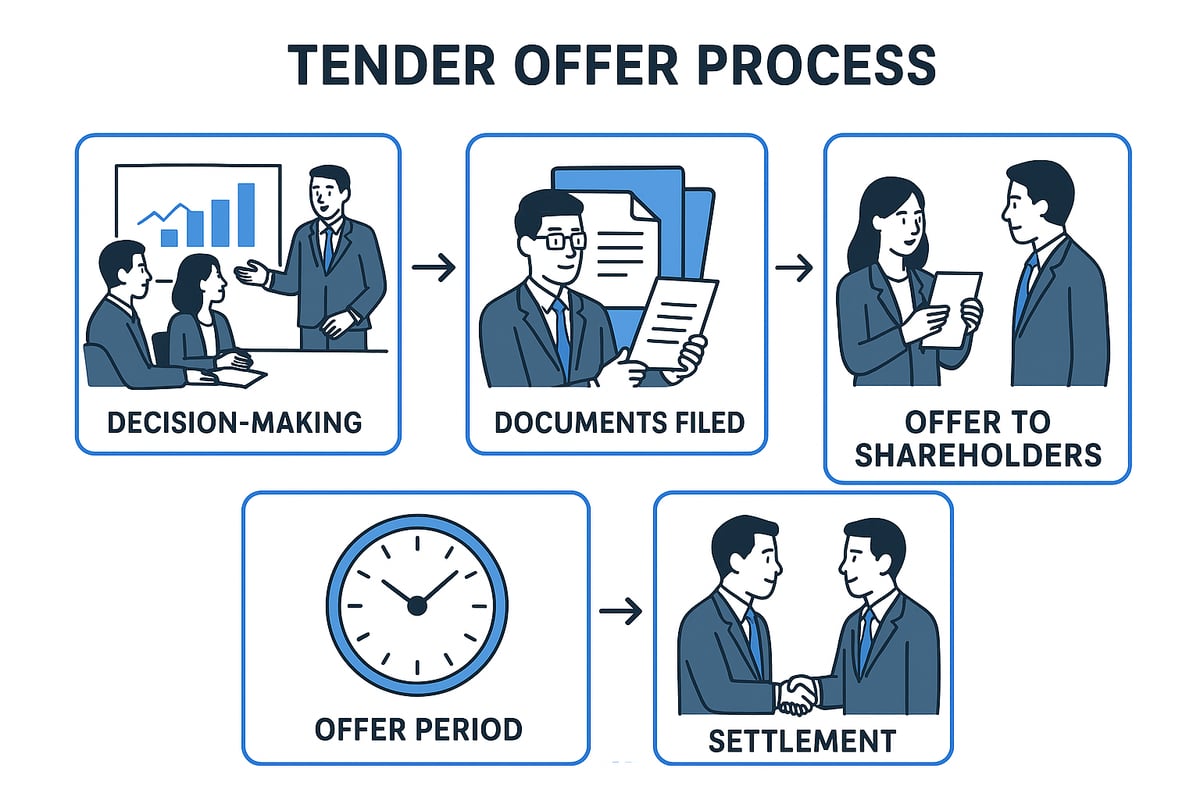
Step 1: Preparation and Announcement
The tender offer process starts with careful planning and internal approvals. A company’s board of directors, with input from legal and financial advisors, decides whether to proceed. Legal counsel reviews compliance requirements and drafts the offer documents with precise terms.
Preparation includes:
- Securing board approval for the tender offer.
- Defining price, quantity, and offer conditions.
- Drafting disclosures and a Schedule TO form.
Next, the company publicly announces the tender offer. Methods include press releases, financial news wires, digital platforms, and sometimes newspaper ads. Prompt, transparent communication is crucial, as investors need clear information to evaluate the proposal.
For example, a typical S&P 500 company may take two to four weeks from the initial decision to the formal announcement. This stage sets the tone for the entire tender offer, ensuring that all stakeholders are adequately informed and the process begins on solid legal ground.
Step 2: Filing and Regulatory Compliance
Once announced, the tender offer must be filed with the Securities and Exchange Commission (SEC) using the Schedule TO form. This filing details the offer’s terms, background, and intent, and it must be submitted before the offer is presented to shareholders.
Key compliance steps include:
- Filing Schedule TO with the SEC.
- Notifying the target company and any relevant stock exchanges.
- Observing the statutory minimum offer period, usually 20 business days.
Missing a regulatory filing or deadline can jeopardize the entire tender offer. In 2025, a missed filing led to an offer being delayed and ultimately withdrawn, highlighting the importance of diligent compliance. The SEC may also require public corrections, which can affect market perception and investor confidence.
Step 3: Offer Period and Shareholder Response
During the offer window, which typically lasts for 20 business days, shareholders receive detailed documents outlining the tender offer’s terms. Communications are sent via email, mail, or digital platforms, ensuring all holders receive equal information.
Shareholders must decide whether to tender their securities, based on:
- The offer price versus current market value.
- Conditions such as minimum or maximum acceptance thresholds.
- Their own investment goals and risk tolerance.
Acceptance rates vary by industry and offer type, but in recent years, US equity tender offers have seen participation rates between 60 percent and 85 percent. Investors should carefully review the disclosures and consider their shareholder rights and considerations before responding. This phase is critical, as the outcome determines whether the tender offer conditions are met and if the transaction will proceed.
Step 4: Modifications and Extensions
Circumstances sometimes require changes to the tender offer, such as increasing the offer price or extending the deadline to allow more shareholders to participate. The SEC regulates these changes strictly, requiring prompt public disclosure of any material modifications.
Common reasons for modifications:
- Insufficient shareholder participation.
- Competing offers from other bidders.
- Changes in market conditions or company performance.
If the offer is extended, all investors must be notified using the same channels as the original announcement. A notable 2024 case involved a high-profile technology firm extending its tender offer three times, each time communicating changes transparently to avoid regulatory issues. Extensions can increase participation but may also introduce uncertainty for both sides.
Step 5: Closing, Settlement, and Post-Offer Actions
Once the offer period ends, the company reviews all tendered securities. If minimum conditions are met, the tender offer closes, and the settlement process begins. Payment is typically made in cash, shares, or a combination, depending on the offer’s terms.
Key steps in the closing phase:
- Accepting or rejecting tendered securities based on offer terms.
- Handling oversubscription by prorating accepted shares if the offer is oversubscribed.
- Disbursing payments promptly, usually within a few business days.
- Updating shareholder registers and, if applicable, integrating acquired assets.
For example, in a 2025 debt tender offer, settlement occurred within five business days after closing, with clear communication throughout. Post-offer actions may include share buybacks, restructuring, or further integration steps, reflecting the strategic goals behind the tender offer. The final outcome impacts both the company’s financial structure and shareholder composition.
Legal, Tax, and Financial Implications
Understanding the legal, tax, and financial implications of a tender offer is essential for both investors and companies. Each aspect can significantly influence decision-making, outcomes, and overall value. This section breaks down the most important considerations to help you navigate the 2026 landscape with confidence.

Legal Considerations and Shareholder Rights
A tender offer triggers a robust legal framework designed to protect all parties. U.S. regulations require full and accurate disclosures, including the bidder's intent, funding sources, and background. Anti-fraud provisions ensure that information is truthful and not misleading.
Shareholders have several important rights during a tender offer:
- The right to decline the offer and retain their shares
- The right to seek or consider competing offers
- The right to receive equal treatment, as all holders must be offered the same price and terms
The board of directors plays a pivotal role. They may issue a recommendation, remain neutral, or provide a fairness opinion. In hostile tender offer scenarios, the board may not endorse the bid, but they must still communicate their reasoning transparently.
Recent cases have shown that failing to provide adequate disclosures or engaging in coercive tactics can result in severe penalties. Regulatory scrutiny is high, and even minor violations can lead to investigations or enforcement actions.
Tax Consequences for Investors
For investors, participating in a tender offer is a taxable event. When shares are tendered, any gain or loss is realized and must be reported on tax returns. The nature of the gain—short-term or long-term—depends on how long the investor held the securities before the tender offer.
Here's a summary of tax scenarios:
| Holding Period | Type of Gain/Loss | Tax Rate Applies |
|---|---|---|
| Less than 1 year | Short-term | Ordinary income rates |
| More than 1 year | Long-term | Capital gains rates |
U.S. investors must report proceeds from a tender offer on their annual filings. Proper documentation is critical, as errors may lead to audits or penalties. Hypothetically, if an investor bought shares at $8 and tenders at $11.50, the $3.50 difference (minus any transaction costs) is taxable.
Tax regulations can change, so consulting a tax professional before acting on a tender offer is wise. This ensures accurate reporting and helps optimize tax outcomes.
Financial Impact on Companies and Markets
A tender offer can dramatically impact a company's financial health and market perception. When a premium is offered, the stock price often rises, reflecting heightened demand and potential value. After the transaction, volatility may occur as the market absorbs the new ownership structure.
In the case of debt tender offers, companies can reduce their outstanding liabilities, potentially improving their credit profile. The effect on the debt-to-equity ratio in tender offers is a key metric for analysts, as it signals changes in financial leverage and risk.
Market sentiment can be influenced by the perceived motives behind a tender offer. Share buybacks may signal confidence, while unsolicited bids could create uncertainty. On average, U.S. tender offers see premiums of 15-25 percent over market price, but the final impact depends on the offer's success and subsequent company actions.
A thorough understanding of these financial implications allows investors and companies to make informed choices and mitigate potential risks.
Strategies and Best Practices for 2026 Tender Offers
Navigating a tender offer in 2026 requires a well-informed approach for both investors and companies. With evolving regulations and digital advancements, understanding the best strategies can make the difference between success and costly mistakes.
For Investors: Evaluating a Tender Offer
When facing a tender offer, investors should start by comparing the offer price to the current market value and the underlying fundamentals of the company. Is the premium attractive enough to justify selling, or does the company’s future potential outweigh the immediate gain?
Review all offer documents thoroughly. These provide crucial details about terms, conditions, and deadlines. Look for any minimum or maximum acceptance thresholds that might affect your ability to tender all your shares.
Consider alternative scenarios. Could another bidder emerge, or might market conditions shift before the offer closes? Assess the risks, such as proration if the offer is oversubscribed, or the chance of partial acceptance if not enough shareholders participate.
Key steps for investors include:
- Comparing the tender offer price to historic trading ranges.
- Researching the bidder’s background and strategic intent.
- Consulting tax and financial advisors for personalized guidance.
A recent tech sector tender offer showed that investors who evaluated both the premium and the company’s growth prospects made more informed decisions. By weighing immediate liquidity against long-term value, you position yourself to act in your own best interest during a tender offer.
For Companies: Planning and Executing a Successful Tender Offer
Companies must define clear objectives before launching a tender offer. Whether the goal is a buyback, acquisition, or restructuring, aligning the tender offer with broader corporate strategy is essential.
Regulatory compliance is non-negotiable. Prepare detailed disclosures, file timely documents, and ensure transparent communication with shareholders. Engaging experienced legal and financial advisors helps navigate complex regulations and avoid missteps.
A robust communication plan is vital. Use multiple channels—press releases, digital platforms, and direct notifications—to reach all stakeholders. For issuer buybacks, consider how sinking fund and buybacks mechanisms can support your strategy and enhance credibility in the market.
Best practices for companies include:
- Conducting internal reviews and securing board approvals before proceeding.
- Drafting clear, concise offer documents in plain English.
- Monitoring shareholder sentiment and being ready to adapt if conditions change.
A Fortune 500 company’s successful tender offer in 2025 highlighted the value of early planning, comprehensive disclosures, and proactive communication. By following these best practices, companies can maximize participation and achieve their strategic aims through a tender offer.
Common Pitfalls and How to Avoid Them
Despite careful planning, several pitfalls can undermine a tender offer. Inadequate or late disclosures may trigger regulatory scrutiny or even enforcement action. Misjudging shareholder sentiment or market timing can result in low participation or unfavorable outcomes.
Companies should be especially vigilant about evolving rules, particularly for private entities. Reviewing resources like Tender Offer Rules & Regulations for Private Companies can help ensure compliance and avoid costly delays.
Other common mistakes include:
- Failing to update offer terms promptly if market conditions shift.
- Underestimating the importance of clear, timely communication.
- Overlooking the necessity of securing funding or regulatory approvals before launch.
Learning from past failed tender offers reveals that regulatory missteps and poor communication are leading causes of unsuccessful outcomes. By staying informed, consulting experts, and prioritizing transparency, stakeholders can mitigate risks and execute a smooth tender offer process.
Special Topics: Variations and Evolving Trends in Tender Offers
In recent years, the landscape of the tender offer has evolved dramatically. From new deal structures to digital processes, understanding these trends is essential for making informed decisions in 2026.
Mini-Tender Offers, Debt Tenders, and Exchange Offers
Not all tender offer transactions are created equal. Three key variations shape the market: mini-tender offers, debt tender offers, and exchange offers.
Mini-tender offers involve an offer to purchase less than 5% of a company's shares. Because these offers fall below the regulatory threshold for full SEC oversight, they come with lighter disclosure requirements and higher risk for investors. Scams and below-market pricing are more common in this space. For example, in 2024, an investment firm targeted retail investors with a mini-tender offer for a popular tech stock, offering a slight premium but lacking clear disclosures. Many investors unknowingly tendered their shares at prices well below prevailing market rates.
Debt tender offers are used by companies seeking to refinance or reduce their debt load. In these transactions, issuers invite bondholders to tender their securities, often at a premium to the market price. Debt tender offers have surged in popularity as interest rates fluctuate and companies look to optimize their balance sheets.
Exchange offers present a different structure. Instead of cash, companies offer new securities in exchange for outstanding ones. This strategy is common in corporate restructuring or when companies want to manage liabilities without significant cash expenditure.
The table below summarizes these variations:
| Type | What Is Offered | Regulatory Oversight | Common Use Case |
|---|---|---|---|
| Mini-Tender Offer | <5% of shares, cash | Limited | Targeting retail |
| Debt Tender Offer | Bonds, cash | Full SEC | Refinancing |
| Exchange Offer | Securities for securities | Full SEC | Restructuring |
Staying alert to these tender offer types helps both companies and investors evaluate risks and opportunities more effectively.
Digitalization and the Future of Tender Offers
Digital transformation is changing how the tender offer process works. Announcements and communications now often occur on secure digital platforms, rather than through traditional newspaper ads or mailed documents. Electronic tendering and settlement have become standard, streamlining the experience for all parties.
In 2025, the US saw its first fully digital tender offer, where every step, from announcement to settlement, was handled electronically. This innovation reduced administrative delays and improved transparency for investors. Modern platforms also enable real-time tracking of tender submissions and instant communication about offer modifications or extensions.
Looking ahead to 2026, regulatory bodies like the SEC are expected to further update disclosure and communication rules. These anticipated changes aim to accommodate digital channels and ensure investor protections keep pace with technology. For a comprehensive overview of recent rule changes affecting digital communication in takeovers and tender offers, see the Final Rule: Regulation of Takeovers and Security Holder Communications.
As digitalization accelerates, both companies and investors must adapt to new workflows and stay vigilant about cybersecurity risks. Embracing digital tools can make the tender offer process more efficient and accessible, but due diligence remains crucial.
Case Studies: Recent High-Profile Tender Offers
Examining recent case studies provides valuable lessons for anyone navigating a tender offer in 2026. In 2024 and 2025, several high-profile deals in both the US and global markets showcased evolving strategies and outcomes.
One notable example involved a major pharmaceutical company launching a tender offer at a 22% premium to market price. Strong shareholder participation led to a rapid acceptance and successful acquisition. In contrast, a mini-tender offer targeting a Fortune 500 tech firm faced regulatory scrutiny due to misleading disclosures and was ultimately withdrawn, highlighting the importance of transparency.
Trends emerging from these cases include a rise in competitive bidding, increased use of digital platforms, and greater focus on shareholder communication. Data from recent years shows that average premiums offered have ranged from 15% to 25%, with participation rates climbing as investors become more familiar with the tender offer process.
For those interested in related deal structures, management buyouts often use a tender offer as their mechanism, as explained in this resource on Management buyout explained.
By studying these examples, stakeholders gain insights into best practices, common pitfalls, and the evolving regulatory environment shaping the tender offer market.
As we’ve explored the ins and outs of tender offers and what’s ahead in 2026, you can see how critical it is to understand both the history and the changing landscape of financial markets. Whether you’re looking to make smarter investment decisions, deepen your research, or simply stay informed, there’s real value in seeing how past market events shape today’s opportunities. If you’re curious to experience financial history in a whole new way and want to be among the first to shape this innovative platform, Join our beta and help us bring history to life.