
Corporate Bond: A Complete Guide for Market Historians
The corporate bond market has served as a fundamental pillar of modern finance for over a century, enabling companies to raise capital while offering investors predictable income streams. Understanding how corporate bonds function in the bond market requires examining both their structural mechanics and their historical evolution through various economic cycles. A corporate bond represents a debt security issued by a corporation to finance operations, expansion projects, or refinancing existing obligations, distinguished from government bonds by higher yields that compensate investors for additional credit risk. This debt instrument has shaped countless business success stories while also featuring prominently in some of history's most significant financial crises.
The Fundamental Structure of Corporate Bonds
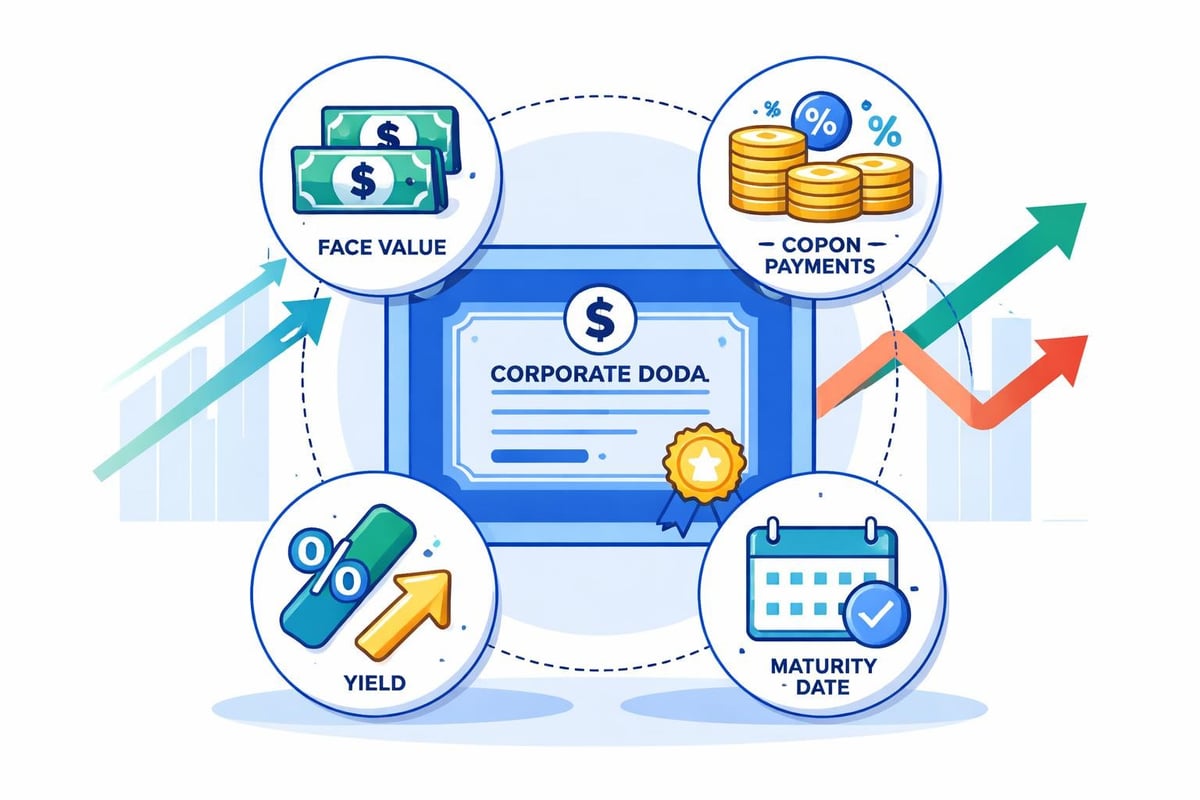
A corporate bond functions as a loan agreement between a company and investors, where the issuing corporation promises to repay the principal amount at a specified maturity date while making periodic interest payments, known as coupon payments, throughout the bond's life. The face value typically amounts to $1,000 per bond, though institutional offerings may carry higher denominations.
Key Components and Terms
Understanding corporate bond terminology proves essential for analyzing historical market movements and investment strategies:
- Principal: The amount the issuer must repay at maturity
- Coupon Rate: The annual interest rate paid to bondholders
- Maturity Date: When the principal must be repaid
- Credit Rating: Assessment of the issuer's creditworthiness
- Yield: The effective return an investor receives
The pricing mechanism for corporate bonds reflects market conditions, interest rate movements, and perceived credit risk. When market interest rates rise, existing bond prices fall to maintain competitive yields, creating inverse relationships that have characterized bond markets throughout history. This dynamic has enabled investors to spot patterns across different economic periods.
Historical Evolution and Market Development
The modern corporate bond market emerged in the late 19th century as American railroads sought capital for westward expansion. These early issues established precedents for credit analysis, documentation standards, and investor protections that continue shaping markets today. The Pennsylvania Railroad's bonds, traded actively in the 1870s, demonstrated how corporations could access capital markets beyond traditional bank lending.
During the 1920s, the corporate bond market experienced explosive growth as industrial expansion created unprecedented capital demands. Companies ranging from utilities to manufacturers issued bonds to finance electrification, factory construction, and technological advancement. This boom period established many practices still used in contemporary markets, including detailed prospectuses and third-party credit ratings.
Depression-Era Transformations
The Great Depression fundamentally altered corporate bond markets through massive defaults and regulatory reforms. Between 1930 and 1933, default rates exceeded 10% annually, devastating portfolios and eroding investor confidence. These experiences led to the Securities Act of 1933 and Securities Exchange Act of 1934, which mandated disclosure requirements and established the Securities and Exchange Commission.
| Era | Default Rate | Key Development | Market Impact |
|---|---|---|---|
| 1920s Boom | <2% | Rapid expansion | Market maturation |
| Great Depression | 10%+ | Regulatory reform | Investor protection |
| Post-WWII | 1-3% | Rating agencies | Credit standardization |
| 1980s-1990s | 3-5% | High-yield market | Risk segmentation |
The post-war period saw corporate bond markets evolve alongside economic expansion and financial innovation. The development of underwriter syndicates enabled larger offerings, while improving telecommunications facilitated national distribution networks. By the 1960s, the corporate bond market had become thoroughly institutionalized with standardized practices and sophisticated pricing models.
Types and Classifications of Corporate Bonds
Corporate bonds encompass diverse structures designed to meet varying issuer needs and investor preferences. Investment-grade bonds, rated BBB- or higher by major agencies, offer lower yields reflecting reduced default risk. These securities have historically served as portfolio stabilizers, particularly during equity market turbulence.
High-yield bonds, often called junk bonds, emerged as a distinct asset class during the 1980s when Michael Milken and Drexel Burnham Lambert pioneered their use in corporate takeovers. These instruments carry ratings below BBB- and compensate investors with substantially higher coupon rates, typically 3-5 percentage points above comparable investment-grade issues.
Specialized Bond Structures
Convertible bonds grant holders the option to exchange their bonds for a predetermined number of company shares, creating hybrid securities that participate in equity upside while providing downside protection through fixed-income characteristics. Technology companies have frequently used convertibles to minimize cash interest payments while in growth phases.
Callable bonds include provisions allowing issuers to redeem bonds before maturity, typically when interest rates decline sufficiently to make refinancing attractive. This feature benefits issuers but introduces reinvestment risk for bondholders, who may receive their principal when favorable reinvestment opportunities have disappeared.
Examining the mechanics of different corporate bond types reveals how companies strategically select structures matching their financial circumstances and market conditions. Puttable bonds, secured bonds, and floating rate notes each serve specific purposes in corporate capital structures.

Credit Risk Assessment and Rating Agencies
Credit rating agencies emerged as critical market intermediaries following the railroad bond defaults of the late 1800s. John Moody launched the first bond rating service in 1909, establishing analytical frameworks that persist in modified form today. These agencies evaluate issuers' financial strength, business models, competitive positions, and macroeconomic environments to assign ratings indicating default probability.
The rating scale extends from AAA (highest quality) through intermediate grades to D (default). Each notch represents statistically significant differences in historical default rates. AAA-rated corporate bonds have exhibited default rates below 0.5% over 10-year periods, while B-rated bonds default approximately 20-30% of the time over similar horizons.
Rating Agency Methodologies
Modern rating analysis examines numerous quantitative and qualitative factors:
- Financial metrics including debt-to-equity ratios and interest coverage
- Industry position and competitive advantages
- Management quality and strategic direction
- Regulatory environment and political risks
- Economic cycle sensitivity and diversification
The 2008 financial crisis exposed significant rating agency failures, particularly regarding structured finance products. Agencies had assigned AAA ratings to mortgage-backed securities that subsequently suffered catastrophic losses, demonstrating how conflicts of interest and methodological limitations can produce systematically biased assessments. These failures prompted regulatory reforms including the Dodd-Frank Act's Title IX provisions.
Yield Calculations and Pricing Mechanisms
Corporate bond yields reflect compensation for time value of money, expected inflation, and credit risk premiums. The spread between corporate and Treasury yields of comparable maturity represents the additional return investors demand for assuming default risk. These spreads widen during economic uncertainty and compress during expansionary periods, creating cyclical patterns observable throughout market history.
Current yield equals the annual coupon payment divided by the bond's market price, providing a simple approximation of return. However, yield to maturity offers a more comprehensive measure by accounting for capital gains or losses as bonds approach par value at maturity. When bonds trade below face value, yield to maturity exceeds the coupon rate, while premium bonds exhibit yields below their coupon rates.
The concept of duration measures bond price sensitivity to interest rate changes, enabling portfolio managers to assess and manage interest rate risk. A bond with duration of 5 years will decline approximately 5% in value for each 1% increase in market interest rates, relationships that have proven remarkably consistent across historical periods.
| Bond Price | Coupon Rate | Current Yield | Yield to Maturity | Duration |
|---|---|---|---|---|
| $950 | 5% | 5.26% | 5.85% | 4.2 years |
| $1,000 | 5% | 5.00% | 5.00% | 4.5 years |
| $1,050 | 5% | 4.76% | 4.20% | 4.8 years |
Market Dynamics and Trading Characteristics
Unlike stocks traded on centralized exchanges, corporate bonds primarily trade in over-the-counter markets through dealer networks. This structure creates less price transparency and wider bid-ask spreads, particularly for infrequently traded issues. Historical liquidity patterns show that recently issued bonds trade more actively than older securities, even when fundamental characteristics remain similar.
Edward Jones highlights practical considerations for investors navigating corporate bond markets, including minimum purchase requirements and transaction costs. Individual investors often access corporate bonds through bond funds or exchange-traded funds rather than purchasing individual securities, gaining diversification while accepting management fees.
The primary market for corporate bonds involves new issuance where companies work with investment banks to structure offerings, set pricing, and distribute securities to investors. Underwriters typically purchase entire offerings and resell bonds to institutional and retail investors, earning spreads as compensation for this distribution service.

Historical Case Studies and Market Events
The Penn Central Railroad bankruptcy in 1970 sent shockwaves through corporate bond markets, marking the largest corporate failure in American history at that time. The company had issued substantial commercial paper-short-term corporate debt-that investors assumed carried minimal risk. The default revealed dangerous assumptions about credit quality and prompted reforms in money market regulations.
During the savings and loan crisis of the 1980s and early 1990s, many financial institutions failed after issuing bonds to fund aggressive real estate lending. Bondholders suffered significant losses, while government intervention through the Resolution Trust Corporation prevented complete market collapse. These events demonstrated how regulatory failures and perverse incentives can destabilize entire industry sectors.
The 2008 Financial Crisis Impact
The 2008 crisis produced unprecedented stress in corporate bond markets as credit spreads exploded to historic levels. Investment-grade corporate bonds traded at spreads exceeding 600 basis points above Treasuries in late 2008, compared to typical spreads of 100-200 basis points. High-yield spreads exceeded 2,000 basis points as investors feared cascading defaults.
Federal Reserve interventions, including the Commercial Paper Funding Facility and later corporate bond purchase programs, stabilized markets and enabled gradual normalization. These extraordinary measures established precedents for central bank involvement in credit markets that continue influencing policy responses to subsequent crises, including the 2020 pandemic recession.
Risk Factors and Investment Considerations
Corporate bond investors face multiple risk categories that have manifested differently across historical periods. Credit risk, the possibility of issuer default, remains paramount and varies substantially across rating categories and economic cycles. Historical data shows default rates spike during recessions, with particularly severe increases in speculative-grade segments.
Interest rate risk creates inverse relationships between bond prices and market yields, relationships that have proven especially challenging during periods of rising rates. The bond market rout of 1994, triggered by unexpected Federal Reserve tightening, inflicted substantial losses on bond portfolios despite minimal credit deterioration.
Additional considerations include:
- Liquidity risk: Difficulty selling bonds without significant price concessions
- Call risk: Early redemption by issuers when rates decline
- Inflation risk: Erosion of purchasing power from fixed payments
- Event risk: Unexpected corporate actions like leveraged buyouts
Analyzing how these risks interacted during historical crises provides valuable context for contemporary investment decisions. The efficient market hypothesis suggests that corporate bond prices efficiently incorporate available information, though behavioral finance research reveals systematic pricing anomalies during stress periods.
Modern Market Trends and Innovations
The corporate bond market has undergone substantial evolution since 2000, driven by technology, regulation, and monetary policy. Electronic trading platforms have gradually increased price transparency and improved execution quality, though corporate bonds remain less liquid than equities. Post-crisis regulations including Dodd-Frank and Basel III have reshaped dealer inventory management and market-making economics.
Quantitative easing programs implemented by major central banks created unprecedented demand for corporate bonds, compressing yields to historic lows. Investment-grade corporate bonds traded at yields below 2% in 2020, levels previously considered impossible for credit-risky securities. This environment forced income-oriented investors into higher-risk segments and prompted concerns about asset price distortions.
Environmental, social, and governance considerations have emerged as significant factors in corporate bond markets, with green bonds and sustainability-linked bonds growing rapidly. These instruments tie interest rates or covenants to specific environmental or social outcomes, creating alignment between corporate behavior and investor preferences. Issuance exceeded $500 billion globally in 2021, demonstrating mainstream adoption.
The pandemic-era market disruptions of March 2020 tested corporate bond markets severely, with spreads widening dramatically and liquidity evaporating temporarily. Federal Reserve intervention through direct corporate bond purchases-unprecedented in American history-stabilized markets within weeks. These actions sparked debate about moral hazard, market efficiency, and appropriate central bank mandates that continue influencing policy discussions.
Understanding corporate bond markets through historical analysis reveals patterns and principles that transcend individual market cycles, enabling more informed investment decisions and risk assessment. By examining how these instruments have evolved across different economic regimes, credit events, and regulatory frameworks, market participants gain perspective on current conditions and potential future developments. Historic Financial News empowers investors, students, and researchers to explore corporate bond market history through interactive charts and AI-powered analysis, connecting past market movements with contemporary investment challenges. Our platform provides the historical context needed to recognize patterns, understand precedents, and make more informed decisions in today's complex fixed-income markets.