
Call Option Guide: Mastering Strategies for 2025
In 2025, options trading is projected to surpass $500 billion in daily volume, making mastery of the call option more crucial than ever. Investors and traders alike are seeking new ways to maximize profit and control risk in today’s fast-moving markets.
This guide is designed to help you understand and master every aspect of the call option. You will learn foundational concepts, explore how call options are priced, discover leading strategies and advanced techniques, and gain practical risk management skills.
Ready to unlock the full potential of call option trading? Dive in and take the next step toward financial confidence and success in 2025.
Understanding Call Options: Core Concepts for 2025
A call option is a financial contract that gives the buyer the right, but not the obligation, to purchase an underlying asset at a predetermined price within a specific timeframe. In 2025, with the surge in options trading, understanding the call option is essential for anyone seeking to profit or manage risk in dynamic markets.

Key Terms in Call Option Trading
Several key terms define how a call option works. The strike price is the agreed-upon price at which the asset can be bought. The expiration date is the last day the option can be exercised. The premium is the price paid for the call option. The underlying asset is typically a stock, index, or ETF. Each standard equity call option contract usually represents 100 shares, making these contracts highly leveraged tools.
Understanding these terms is critical before entering any call option trade. They determine both your potential profit and risk.
American vs. European-Style Options
Options come in two main styles: American and European. An American-style call option allows the holder to exercise at any time before expiration. In contrast, a European-style call option can only be exercised on the expiration date itself.
For traders, this distinction impacts flexibility and strategy. Most equity options in the U.S. are American-style, while many index options are European-style. Knowing which style you are trading helps you manage your positions effectively.
Example: Buying a Call Option in 2025
Imagine you are bullish on a technology company in 2025. You decide to buy a call option on a leading growth stock. Suppose the stock trades at $120, and you purchase a call option with a $125 strike price, expiring in one month, for a $3 premium. If the stock rises to $135 before expiration, you can exercise your right to buy at $125 and profit from the difference, minus the premium paid.
Growth stocks are common underlying assets for call option trades, as they often experience rapid price movements. For more details on these assets, see Growth stocks and options.
Uses of Call Options: Speculation, Hedging, and More
Call option contracts are versatile. Traders use them to speculate on rising prices while limiting risk to the premium paid. Investors may hedge short positions or create synthetic exposures. In portfolio management, call options can boost returns or provide downside protection.
The flexibility of a call option makes it a valuable tool for both aggressive and conservative market participants.
Comparing Calls and Puts
A call option differs from a put option, which gives the right to sell the underlying asset at a set price. Calls benefit from rising prices, while puts profit from declines. The risk for a call option buyer is limited to the premium, but potential reward can be substantial if the market moves favorably.
Calls and puts often form the foundation of more advanced strategies, each with unique risk and reward profiles.
Understanding Contract Specifications
Before trading any call option, review the contract specifications. These include the underlying asset, contract size, expiration date, and exercise style. Each detail impacts your risk and potential reward.
A thorough understanding of call option contracts is vital for confident and effective trading in 2025.
How Call Options Are Priced: Factors and Models
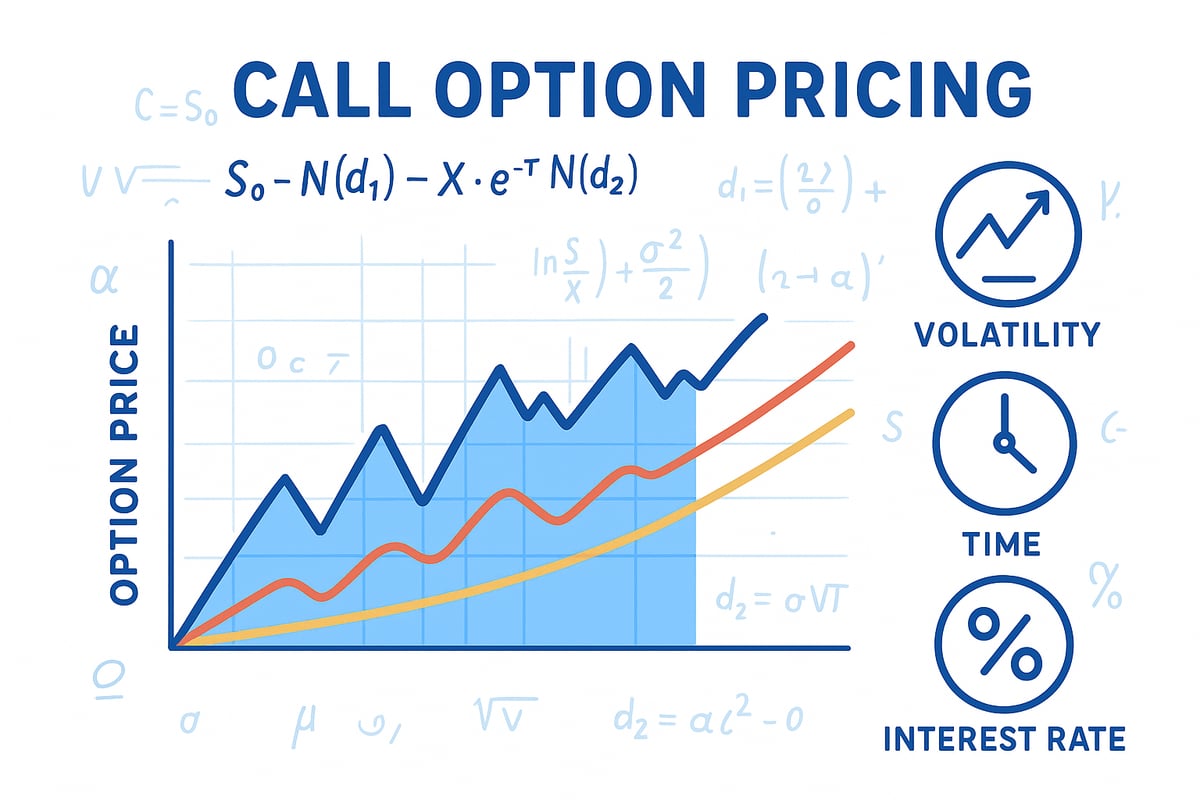
Understanding how a call option is priced is essential for every trader in 2025. The value you see on your screen is not random. It results from a blend of market forces, complex models, and human psychology. Let’s break down the process so you can approach each call option trade with confidence.
Intrinsic Value and Time Value
Every call option price consists of two main components: intrinsic value and time value. Intrinsic value is straightforward. It’s the difference between the current market price of the underlying asset and the strike price, but only if that difference is positive.
For example, if a tech stock trades at $105 and your call option has a strike price of $100, the intrinsic value is $5. If the stock is below $100, the intrinsic value is zero.
Time value is the extra premium you pay for the possibility that the call option could become more profitable before it expires. This value shrinks as expiration approaches, a process known as time decay.
Let’s look at three possible scenarios:
- In the money (ITM): Market price above strike price, positive intrinsic value.
- At the money (ATM): Market price equals strike price, only time value.
- Out of the money (OTM): Market price below strike price, only time value.
For instance, in early 2025, if a call option on a $120 stock has a $115 strike and trades for $8, $5 is intrinsic value and $3 is time value. Understanding this split helps you evaluate each trade.
Key Pricing Influencers: Volatility, Time, and Interest Rates
Several factors can dramatically move a call option’s price. Volatility is one of the biggest. Higher volatility means the underlying asset could swing more, which increases the chance your call option ends up profitable. As volatility rises, premiums go up.
Time to expiration is also crucial. The longer the call option has until it expires, the higher the premium. More time means more opportunity for the stock to move in your favor.
Interest rates play a role, especially in 2025’s dynamic environment. When rates rise, call option prices can increase because holding the option becomes more attractive than buying the stock outright. Dividends, however, can lower call option values, since option holders do not receive them.
Consider this data: “Call contract prices are generally higher when the underlying is more volatile or when more time remains until expiration.” For example, a 3-month call option on a volatile AI stock may cost $7, while a 1-week option on the same stock costs only $1.50.
To sum up, always check these factors before entering a trade:
- Underlying asset volatility
- Time until expiration
- Prevailing interest rates
- Expected dividends
Each one shapes the risk and reward profile of your call option strategy.
Popular Pricing Models: Black-Scholes and Beyond
To put real numbers on a call option’s price, traders and institutions rely on mathematical models. The most famous is the Black-Scholes model, which is widely used for European-style options. This model considers the current stock price, strike price, time to expiration, risk-free rate, and volatility.
Let’s walk through a simplified Black-Scholes calculation:
Call Price = S*N(d1) - K*e^(-rt)*N(d2)
Where S is the stock price, K is the strike price, r is the risk-free rate, t is time, and N(d) is the cumulative probability.
While the Black-Scholes model is powerful, it has limitations, such as assuming constant volatility and no early exercise. For American options or more complex products, traders may use binomial or Monte Carlo models. For a deeper dive into how this works, see the Black–Scholes Model Explained.
Understanding these models helps you make informed decisions and spot opportunities or risks that others might miss.
Essential Call Option Strategies for Every Trader
Unlocking the full potential of the call option requires a toolkit of proven strategies tailored to your market outlook and risk profile. In this section, we guide you through foundational and advanced approaches every trader should master in 2025.

Buying Calls: Leveraged Upside with Defined Risk
Buying a call option is the classic bullish strategy for traders who expect significant upward movement in an asset. This approach lets you control 100 shares for a fraction of the cost compared to buying the stock outright. For example, in 2025, purchasing a call option on a leading tech stock might require only $269, while buying 100 shares could cost $18,800.
The key advantage is capital efficiency. You can achieve leveraged exposure to price gains, as the call option's value increases when the underlying asset rises above the strike price. Your risk is defined and limited to the premium paid, which is especially attractive in volatile markets.
To calculate your break-even point, add the premium to the strike price. If the stock closes above this level at expiration, your call option is profitable. If not, your maximum loss is the premium. This strategy is ideal for traders seeking upside with controlled downside.
Selling Covered Calls: Generating Income on Owned Shares
Selling covered calls is a popular income-generating strategy, especially in stable or slowly rising markets. Here, you sell a call option against stock you already own. By collecting the premium, you enhance returns even if the stock moves sideways.
For instance, consider selling an 82.5-strike call option on a $79.34 stock and earning a $2.37 premium per share. If the stock remains below the strike, you keep both the shares and the premium. If the stock rises above the strike, your shares may be called away, capping your upside but locking in gains plus premium income.
This approach is gaining traction, as highlighted in the Growth of Covered Call Strategies. Remember, while covered calls limit upside, you still face downside risk if the stock falls. Reviewing risk profile charts can help visualize these trade-offs before executing a call option strategy.
Protective Calls and Synthetic Positions
Protective calls are powerful tools for hedging short positions, while synthetic positions enable traders to mimic stock ownership or shorting using options. By purchasing a call option while holding a short stock position, you limit potential losses if the asset rises sharply.
Synthetic long positions combine buying a call option with selling a put option at the same strike and expiration. This mirrors the payoff of owning the underlying asset, often with less capital required up front. Traders use these techniques to balance risk and reward, especially in volatile sectors or with index options in 2025.
Consider a scenario where tech sector volatility spikes. Buying a protective call limits your loss on a short trade, while a synthetic long lets you participate in upward moves without tying up large amounts of capital. Understanding when to deploy these call option strategies is essential for robust portfolio management.
Advanced Call Strategies: Spreads, Straddles, and Combinations
Advanced call option strategies help traders fine-tune risk and reward in diverse market environments. Vertical spreads, such as bull call spreads, involve buying one call option and selling another at a higher strike, both with the same expiration. This reduces net cost and limits both risk and potential profit.
Calendar and diagonal spreads use different expirations or strikes to profit from time decay or volatility changes. Straddles and strangles involve buying calls and puts to benefit from large price swings, regardless of direction. For example, a 2025 trader might use a straddle on a biotech stock ahead of major news, capturing gains if the stock moves sharply either way.
Each strategy has a unique risk profile. Using tables and payoff diagrams can clarify outcomes and help you choose the right call option approach for your goals. Mastery of these advanced techniques sets top traders apart in the evolving 2025 market.
Risk Management and Best Practices in Call Option Trading
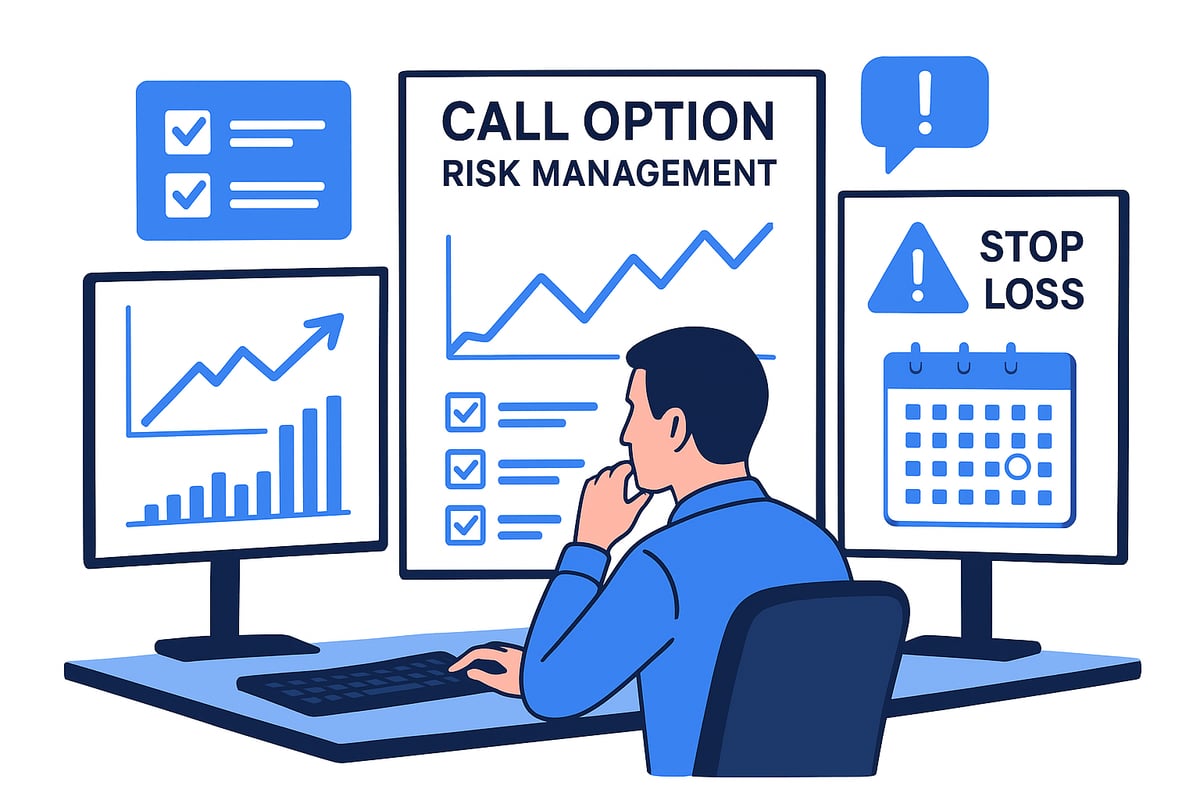
Effectively managing risk is the cornerstone of long-term success in call option trading. The right practices can help you protect capital, avoid costly mistakes, and navigate the dynamic market landscape in 2025.
Assessing and Limiting Risk
Prudent risk assessment is essential before entering any call option trade. For buyers, the maximum loss is limited to the premium paid. However, sellers of uncovered calls face theoretically unlimited risk if the underlying asset’s price surges.
Consider these key risk management tools:
- Position sizing: Only risk a small portion of your portfolio on any single call option trade.
- Stop-loss orders: Set clear exit points to limit losses if the market moves against you.
- Diversification: Spread exposure across different sectors or strategies.
The table below summarizes risk profiles:
| Role | Max Loss | Max Gain |
|---|---|---|
| Call Option Buyer | Premium Paid | Unlimited |
| Uncovered Call Seller | Unlimited | Premium Received |
| Covered Call Seller | Downside in Stock Value | Premium + Stock Upside (capped) |
Remember, options carry a high level of risk and are not suitable for all investors. Even experienced traders can encounter unexpected volatility, so discipline and preparation are non-negotiable.
Managing Expiration and Assignment
Understanding what happens at expiration is vital for call option traders. At expiration, you can exercise the option, sell it, or let it expire worthless. For American-style options, assignment can occur at any time before expiration, especially if the option is in the money.
Assignment risk is highest for uncovered call sellers. If assigned, you must deliver the underlying shares at the strike price, which can result in significant losses. Rolling your position—closing the current option and opening a new one with a later expiration—can help avoid unwanted assignment and maintain your strategy.
Staying informed about your positions and monitoring them closely is crucial. Use platform alerts and keep a calendar of all key expiration dates to stay ahead.
Tax Implications and Record-Keeping
Every call option trade has tax consequences. Profits from options held less than a year are typically taxed as short-term capital gains, while long-term rates may apply for longer holding periods. Consult the latest IRS guidelines to ensure compliance.
Detailed record-keeping is a must. Log each trade’s date, strike price, premium, and outcome. This simple code block illustrates an organized record:
Trade Date | Symbol | Strike | Expiry | Type | Premium | Outcome
2025-02-10 | AAPL   | 180    | 2025-03-15 | Call | $2.50   | Sold for $3.10
Accurate records will simplify your tax filing and help you analyze performance over time.
Common Mistakes to Avoid
Several recurring mistakes can undermine your call option results. Watch out for these pitfalls:
- Overleveraging positions, risking too much on a single trade
- Ignoring volatility and its impact on option pricing
- Misunderstanding contract specifications or assignment risks
- Failing to follow a disciplined trading plan
Learning from industry authorities, such as the Options Strategies Overview, can help you refine your strategy and avoid common errors. Establish a routine for reviewing trades and updating your plan as markets evolve.
Adapting Call Option Strategies for the 2025 Market Landscape
Adapting your call option approach is essential as the 2025 market landscape brings new challenges and opportunities. Rapid shifts in technology, macroeconomic forces, and trading tools are reshaping the way traders select and manage call option strategies. To stay profitable and protected, you need to understand how these changes impact your choices.
2025 Market Trends and Their Impact on Call Options
The 2025 market is defined by high volatility in tech, shifting interest rates, and increasing geopolitical risks. These trends directly influence call option pricing and strategy selection. For example, tech stocks continue to experience rapid price swings, making volatility a central factor in call option premium calculations.
Interest rates remain elevated compared to previous years, increasing the cost of holding positions and affecting the attractiveness of various call option strategies. Geopolitical tensions can trigger sudden spikes in volatility, causing call option prices to fluctuate rapidly. According to competitor data, options trading volume is projected to surpass $500 billion daily in 2025, signaling greater liquidity and tighter spreads for active traders.
Market efficiency also plays a significant role in call option trading. Understanding the Efficient market hypothesis explained helps traders recognize how quickly information is reflected in option prices, making it harder to find mispriced contracts. To succeed, traders must adapt strategies to these fast-moving conditions and remain vigilant about macroeconomic developments.
Choosing the Right Strategy for Your Goals
Selecting the most effective call option strategy requires aligning your approach with your unique objectives and risk profile. Are you aiming to speculate on upward price movement, generate steady income, or hedge existing positions? The answer will guide your choice in 2025's dynamic environment.
For speculation, buying a call option provides leveraged upside with defined risk. If income is your goal, selling covered calls on owned shares can generate premiums, though it caps potential gains. Those seeking risk reduction may use protective calls to hedge short positions or create synthetic exposures.
Market conditions in 2025 demand careful evaluation of volatility, interest rates, and liquidity before executing any call option strategy. Decision trees or flowcharts can help clarify the most suitable approach for your situation. Always match your chosen strategy to your market outlook and risk tolerance to maximize success.
Technology, Tools, and Platforms for Modern Option Traders
Technology is transforming the way traders approach the call option market in 2025. Leading trading platforms now offer advanced analytics, seamless order execution, and real-time data feeds. Many integrate AI-driven tools to help forecast volatility and identify optimal entry and exit points.
Educational resources are more accessible than ever, with interactive tutorials and simulated trading environments available on most platforms. Regulatory changes have also improved transparency and risk management, making it easier for traders to monitor and control their call option positions.
Selecting a platform with robust analytics, reliable execution, and strong educational support can give you a significant edge in the competitive call option landscape.
Continuing Education and Staying Ahead
Success in call option trading depends on your commitment to continuous learning. Markets shift rapidly, and strategies that work today may not be effective tomorrow. Staying updated through books, online courses, webinars, and reputable news outlets is essential.
Joining trading communities can provide valuable insights and foster disciplined decision-making. Experienced traders often share call option strategies, lessons learned, and market analysis, helping you stay ahead of trends. Make ongoing education a core part of your trading routine to maintain a competitive advantage in 2025.
Step-by-Step Guide: Executing a Call Option Trade in 2025
Ready to execute your first call option trade in 2025? This step-by-step guide walks you through the process, ensuring each decision is informed, strategic, and tailored to today’s fast-moving markets.
Step 1: Define Your Market Outlook and Objectives
Start by clarifying your market view and why you are considering a call option. Are you bullish on a stock, seeking to hedge a short position, or aiming for leveraged exposure?
Set clear profit targets and risk limits before entering a trade. Assess 2025 market conditions using scenario analysis, considering volatility, sector trends, and economic data. Knowing your objectives will help you select the right call option strategy and avoid emotional decisions.
Step 2: Select the Underlying Asset and Expiration
Choose an asset that aligns with your call option thesis. Analyze recent price action, liquidity, and sector news. Use both technical and fundamental tools, such as the price-to-earnings ratio, to gauge value and growth potential.
Decide on an expiration date that matches your outlook. For short-term moves, weekly options may work. For trends or earnings plays, monthly or quarterly expirations offer flexibility. Always confirm the asset’s option liquidity to minimize slippage.
Step 3: Choose the Right Strike Price and Strategy
Selecting the strike price is crucial for your call option trade. Understand moneyness: In-the-money (ITM) options have intrinsic value, at-the-money (ATM) are near the current price, and out-of-the-money (OTM) are further away.
Match the strike to your risk tolerance and market view. For aggressive upside, OTM strikes cost less but need bigger moves. ITM options cost more but respond faster to price changes. Decide if a simple buy or advanced spread best fits your scenario.
Step 4: Calculate Potential Profit and Loss
Before placing any call option trade, calculate your break-even and risk/reward profile. The break-even is the strike price plus the premium paid. Maximum loss equals the premium if the option expires worthless, while upside is theoretically unlimited for a long call.
Here’s a quick example:
| Scenario | Stock at Expiry | Profit/Loss |
|---|---|---|
| Below Strike | $95 | -Premium Paid |
| At Break-Even | $102 | $0 |
| Above Break-Even | $110 | Gain minus Premium |
Use payoff diagrams to visualize outcomes and ensure your expectations are realistic.
Step 5: Place the Trade and Monitor Your Position
Log into your trading platform and select the call option contract that matches your criteria. Enter the order type (limit or market), set your price, and confirm the details.
After execution, monitor key Greeks like delta (price sensitivity), theta (time decay), and implied volatility. Set alerts for price targets and risk levels. Stay updated with real-time news, as sudden events can impact your call option position quickly.
Step 6: Manage, Adjust, or Exit the Trade
As your trade develops, decide when to close, roll, or exercise your call option. If the market moves in your favor, consider taking profits early. For adverse moves, you might roll the position to a later expiration or different strike.
Keep detailed records and review your trade outcomes. Post-trade analysis helps you refine your strategy, manage risk, and improve future call option performance. Adapt your approach based on what you learn from each trade.
Glossary of Key Call Option Terms for 2025
Understanding the language of call option trading is essential for success in 2025. Use this glossary for quick reference as you navigate modern strategies and pricing models.
| Term | Definition & 2025 Context Example |
|---|---|
| Call Option | A contract giving the right to buy an asset at a set price before expiration. Example: Buying a call option on a tech stock to benefit from price increases. |
| Strike Price | The set price at which the call option holder can buy the underlying asset. |
| Expiration Date | The last day the call option can be exercised. Weekly and monthly expirations are common in 2025. |
| Premium | The price paid to purchase a call option contract. |
| Underlying Asset | The financial instrument (stock, ETF, index) the call option is based on. |
| Contract Size | Number of shares per call option, typically 100 for equities. |
| American/European Style | American options can be exercised any time before expiration. European options only at expiration. |
| Assignment | When a call option seller is required to deliver the asset if exercised. |
| Greeks | Metrics (Delta, Theta, Vega, Gamma) that measure sensitivity to market factors. |
| Volatility | Expected price fluctuation, impacting the premium of a call option. Advanced models like Call Option Pricing with Pearson Diffusion account for skewed volatility. |
| Liquidity | How easily a call option can be bought or sold without affecting its price. |
Mastering these terms will help you confidently analyze and execute call option trades in 2025.
As you’ve seen throughout this guide, mastering call option strategies in 2025 requires both a strong grasp of the fundamentals and an ability to spot patterns from the past. If you’re ready to deepen your understanding and gain unique insights into the forces shaping today’s markets, we’re building a platform designed just for you. With interactive charts, AI-powered summaries, and original news coverage, you can explore the stories behind every market move and sharpen your trading edge. Want to be part of this journey and see history come to life in your investing decisions? Join our beta and help us bring history to life.