
Opportunity Cost Guide: Master the Concept in 2026
Every decision you make, from your morning coffee run to choosing a new career, involves a trade-off you might not notice at first glance. What if you could see the hidden price of every choice and make smarter moves for your future?
This guide is designed to help you master opportunity cost in 2026. You will learn how this economic principle shapes your finances, business strategies, and everyday life.
We will break down the definition, explore its significance, and walk through real-world examples and calculation steps. By the end, you will have practical tools to apply opportunity cost for more confident, informed decisions.
Understanding Opportunity Cost: Definition and Core Principles
Every decision you make, from your morning coffee to major life investments, involves an unseen trade-off. This is the heart of opportunity cost, a concept that shapes choices in personal finance, business, and daily living.
Opportunity cost is the value of the next-best alternative you forgo when making a decision. Rather than focusing only on what you choose, it forces you to consider what you give up. This approach uncovers hidden costs and helps you see the real price of your choices.
At the core of opportunity cost lies the principle of scarcity. Resources like money, time, and energy are limited, while our wants and needs often feel endless. Scarcity means every choice comes at the expense of something else. This principle is the foundation of all economic decision-making, driving how individuals, businesses, and governments allocate resources.
The concept of opportunity cost dates back to classical economics. Early economists recognized that trade-offs are unavoidable when resources are scarce. Over time, this idea evolved, influencing modern decision theory and behavioral economics. Today, opportunity cost is a fundamental lens through which economists analyze choices.
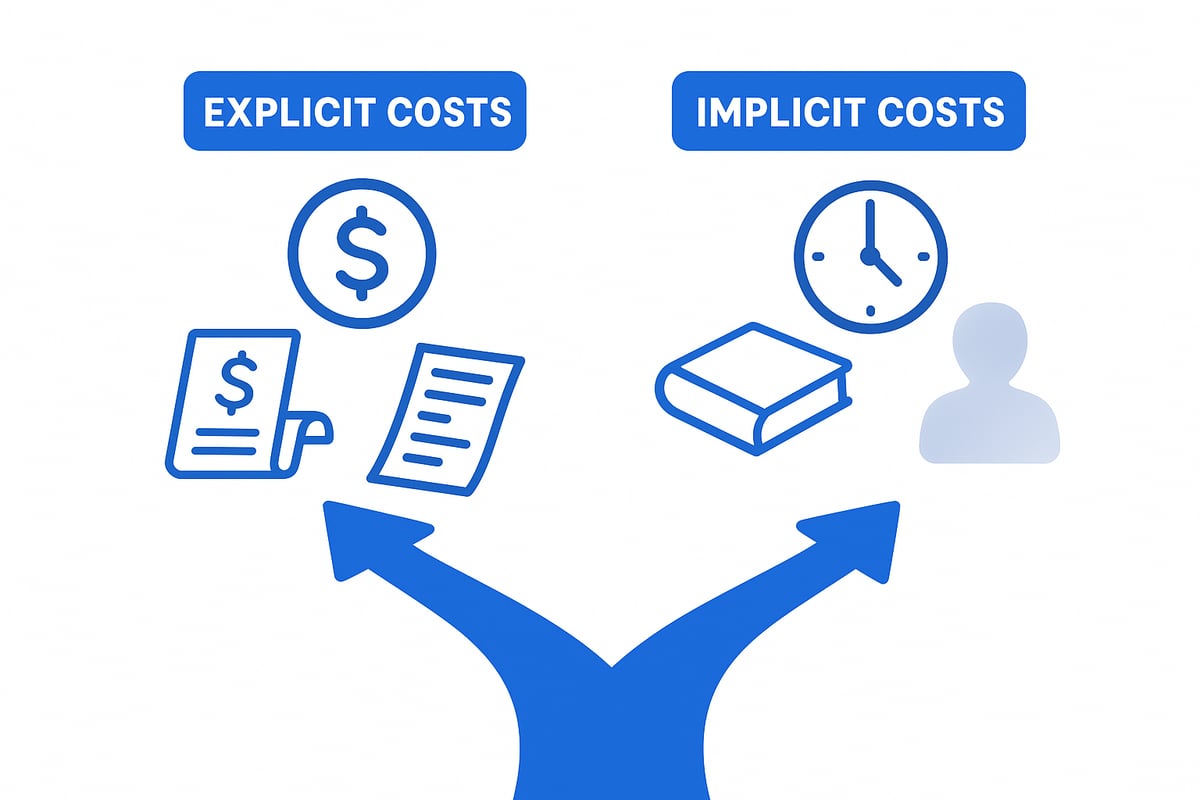
Understanding opportunity cost requires distinguishing between two types of trade-offs: explicit and implicit costs. Explicit costs are direct, out-of-pocket expenses, like buying a movie ticket. Implicit costs represent the value of resources that could have been used elsewhere, such as the time you spend watching that movie instead of working. For a deeper look at these foundational concepts, visit Understanding explicit and implicit costs.
| Type | Description | Example |
|---|---|---|
| Explicit | Direct, monetary cost | Paying $20 for a concert ticket |
| Implicit | Non-monetary, foregone value | Missing work to attend the show |
Time is another crucial factor in opportunity cost. Some choices have immediate effects, while others carry long-term consequences. For instance, spending $7 on a smoothie today might seem minor, but if you invested that money instead, it could grow significantly over time. This future-oriented perspective helps you weigh both present satisfaction and potential gains.
Opportunity cost is not just for economists. It appears in daily life, such as choosing between studying and socializing, or deciding to save money rather than spend it. Each choice involves an explicit cost (money spent) and often a larger, implicit cost (what you miss out on).
Why does this matter? Opportunity cost directly impacts your financial well-being, productivity, and long-term goals. According to the St. Louis Fed, spending $54 a month on coffee rather than investing it at 3% interest could leave you with $7,619 less after 10 years. These small trade-offs can add up to major differences in life outcomes.
By mastering opportunity cost, you unlock a new level of awareness. You become better equipped to prioritize, avoid regret, and make decisions that align with your values and future goals.

Types of Opportunity Costs: Explicit and Implicit Explained
Every decision you make involves a trade-off, but not all trade-offs are created equal. To truly master opportunity cost, it is essential to understand its two main forms: explicit and implicit. Recognizing the differences between these types can help you make smarter, more informed choices in both your finances and your daily life.
Explicit Opportunity Costs
Explicit opportunity costs are the straightforward, out-of-pocket expenses that come with making a choice. These costs are visible and easily recorded, making them the most recognized aspect of opportunity cost.
For example, if you spend $20 on a movie ticket, the explicit opportunity cost is the $20 you could have saved or invested. Another example is purchasing a car upgrade; the money spent on the upgrade cannot be used elsewhere. Identifying explicit costs is simple because they directly impact your budget and cash flow.
In personal finance, tracking explicit opportunity cost means looking at every dollar spent and considering alternative uses. For instance, choosing a $4,000 vacation over investing the same amount can have clear, measurable effects on your future finances. The St. Louis Fed illustrates how a $4,000 trip, if invested at 3 percent interest, could grow to $5,397 in ten years. This demonstrates how explicit opportunity cost can influence both short-term spending and long-term financial growth.
Implicit Opportunity Costs
Implicit opportunity costs are less obvious, yet equally important. These represent the value of resources that are not directly paid out but could have been used differently. Unlike explicit costs, implicit opportunity cost is often “hidden” and relates to non-monetary factors.
Consider the time spent commuting instead of working. The hours lost in traffic could otherwise be used for earning income, developing new skills, or spending time with family. Similarly, choosing leisure over freelance work comes with an implicit opportunity cost: the earnings or experience you forgo.
Implicit costs are crucial in long-term planning and personal well-being. Many individuals overlook these costs, yet they have a significant impact on future opportunities. By factoring in implicit opportunity cost, you can better evaluate the full consequences of your choices, especially when time, energy, or missed learning are involved.
Comparing Explicit and Implicit Costs
Understanding the differences and similarities between explicit and implicit opportunity cost is vital for comprehensive decision-making. Both types represent the value of forgone alternatives, but they differ in visibility and measurability.
| Aspect | Explicit Costs | Implicit Costs |
|---|---|---|
| Visibility | Clearly visible, monetary | Hidden, non-monetary |
| Measurement | Easily measured in dollars | Often qualitative or estimated |
| Examples | Movie tickets, car upgrades | Time, lost experience, missed learning |
| Impact | Immediate on budget/cash flow | Long-term on growth and satisfaction |
Take the case of a student deciding between working part-time and focusing on studies. The explicit opportunity cost is the lost wages from not working. The implicit opportunity cost is the lost learning or future earning potential from not dedicating time to education.
Many people and businesses underestimate implicit opportunity cost, creating blind spots in their decision-making process. Research has shown that opportunity cost neglect is a common issue, where individuals fail to fully consider alternative options. By being aware of both explicit and implicit costs, you can avoid these pitfalls and make more balanced, strategic decisions.
Real-Life Examples of Opportunity Cost in Action
Every decision you make, from buying a daily coffee to choosing a career path, involves opportunity cost. Understanding how this concept plays out in real life can transform your approach to money, work, and time. Let’s look at how opportunity cost shapes our everyday choices.

Everyday Personal Finance Examples
Opportunity cost reveals itself in the smallest daily financial decisions. Consider the popular habit of buying coffee every morning. If you spend $54 per month on coffee and instead invest that amount at a 3% annual interest rate, the St. Louis Fed estimates you could have $7,619 after 10 years. That $7 coffee is not just a treat today, it is money that could have grown over time.
Let’s break down more examples:
- Choosing to eat out regularly rather than cooking at home. The extra money spent on dining could be invested or saved for future goals.
- Paying for streaming services instead of using free educational content. The subscription fees could fund a course or skill development.
- Deciding to buy the latest gadget rather than contributing to a retirement account.
These everyday choices highlight how opportunity cost can quietly influence your long-term financial security. The value of what you give up, even if it seems small now, can add up to a significant sum over time.
Business and Investment Decisions
Opportunity cost is at the core of every business strategy and investment. Imagine a farmer with a limited amount of land. Planting wheat means forgoing the chance to plant corn, each crop offering different returns and risks. The choice directly impacts the farm’s profitability.
In a corporate setting, managers face similar trade-offs:
- Allocating budget to launch a new product versus expanding an existing line. The opportunity cost is the growth potential of the option not chosen.
- Deciding between hiring one candidate over another. The skills and potential contributions of the candidate not selected are part of the calculation.
- Investing in stocks rather than bonds. Each option offers different returns and risk profiles, so the opportunity cost is the foregone benefit of the alternative.
These decisions shape a company’s future growth and resilience. Evaluating opportunity cost helps leaders make informed choices that align with long-term goals.
Time Management and Career Choices
Time, like money, is a limited resource, and its opportunity cost can be profound. Consider the choice between driving to work or taking the train. If the train ride allows for productive work or relaxation, while driving does not, the opportunity cost of driving includes lost time that could have been used more effectively.
Career decisions also involve major opportunity cost considerations:
- Pursuing further education means giving up immediate income from a job, but it could lead to higher earnings in the future.
- Freelancers who accept one project often have to decline others, so the opportunity cost is the income or experience from the projects not pursued.
- Choosing overtime at work instead of spending time with family or on personal development.
Balancing work and life often comes down to recognizing these trade-offs. By understanding opportunity cost, you can allocate your time to maximize both professional growth and personal satisfaction.
How to Calculate Opportunity Cost: Step-by-Step Guide
Calculating opportunity cost may seem complex, but breaking it into steps makes the process practical and actionable. By following a structured approach, you can make smarter decisions in personal finance, business, or any scenario where resources are limited. Let’s walk through each step to master this essential concept.

Step 1: Identify All Alternatives
Begin by listing every possible option available before making a decision. This is the foundation for calculating opportunity cost. Overlooking alternatives can lead to incomplete analysis and missed opportunities.
Consider both obvious and less apparent choices. For example, if you receive a $4,000 bonus, your alternatives might include investing, saving, spending on travel, or paying off debt.
Use brainstorming techniques or data collection to ensure no option is left out. The more thorough your list, the more accurate your opportunity cost calculation will be.
Step 2: Determine the Value of Each Alternative
Once you have your list, assign a value to each alternative. This value may be monetary, such as the expected return from an investment, or qualitative, such as personal satisfaction or time saved.
Use market rates, historical performance, or personal preferences to evaluate each choice. For instance, if investing $4,000 at 3% annual interest, you can project the future value using a simple formula.
Remember, opportunity cost considers both explicit (financial) and implicit (non-financial) values. Assigning accurate values ensures you compare options on a level playing field.
Step 3: Select the Next-Best Alternative
Next, identify the next-best alternative—the option you would choose if your primary choice were unavailable. This step is crucial because opportunity cost always focuses on what you give up for your chosen path.
Be realistic when selecting this alternative. For example, if you decide to spend your bonus on a vacation, the next-best alternative might be investing it for long-term growth.
Making this distinction requires honest self-assessment and understanding your own goals. The clarity gained here directly impacts the accuracy of your opportunity cost analysis.
Step 4: Subtract the Value of the Chosen Option from the Next-Best
Now, calculate the opportunity cost by subtracting the value of the option you chose from the value of the next-best alternative. The formula is straightforward:
Opportunity Cost = Value of Next-Best Alternative - Value of Chosen Option
For example, if investing $4,000 yields $5,397 in 10 years and spending it on a vacation yields immediate satisfaction valued at $4,000, the opportunity cost of the vacation is $1,397.
Include both explicit and implicit values in your calculation. This step quantifies the trade-off and makes the opportunity cost visible for decision-making.
Step 5: Analyze and Apply the Results
Finally, use your opportunity cost calculation to inform your decisions. Consider both short-term and long-term effects, as some costs may not be immediately apparent.
Ask yourself: Does the benefit of the chosen option outweigh what you give up? If not, you may want to reconsider your choice.
Apply this approach to future decisions for continuous improvement. Understanding opportunity cost helps you allocate resources more effectively, avoid regret, and achieve your goals with confidence.
Opportunity Cost in Economics, Business, and Government Policy
Understanding opportunity cost is essential for navigating the worlds of economics, business, and public policy. This principle shapes how profits are calculated, trade decisions are made, and public funds are allocated. Let’s break down how opportunity cost influences these critical areas.
Economic Profit vs. Accounting Profit
Opportunity cost is central to understanding the difference between economic profit and accounting profit. While accounting profit simply subtracts explicit costs from revenue, economic profit goes further. It factors in both explicit and implicit costs, including the value of alternatives forgone.
For example, consider an entrepreneur who leaves a salaried job to start a new business. The salary not earned is an implicit cost, representing the opportunity cost of entrepreneurship. While accounting profit may appear positive, true economic profit could be lower or even negative after including this opportunity cost.
Here’s a quick comparison:
| Profit Type | Calculation | Includes Opportunity Cost? |
|---|---|---|
| Accounting Profit | Revenue minus explicit costs | No |
| Economic Profit | Revenue minus explicit and implicit costs | Yes |
To explore this further, see Economic profit explained for a detailed breakdown of how opportunity cost impacts business decisions.
By considering opportunity cost, businesses gain a more accurate picture of their true financial health and can make smarter strategic choices.
Comparative and Absolute Advantage
Opportunity cost also plays a foundational role in international trade and specialization. The theory of comparative advantage states that individuals or countries should specialize in producing goods where they have the lowest opportunity cost. This enables all parties to benefit from trade, even if one is more efficient at producing everything.
For instance, if Country A can produce both cars and computers more efficiently than Country B, both can still gain by specializing where their opportunity cost is lowest. Country A might focus on computers if its opportunity cost for car production is higher, while Country B produces cars. This way, total output and welfare increase for both.
Absolute advantage, on the other hand, looks only at who can produce more with fewer resources. Comparative advantage, rooted in opportunity cost, is the key driver for mutual benefit in trade.
Recognizing the role of opportunity cost in these decisions helps businesses and nations allocate resources more effectively and gain a competitive edge.
Government and Public Policy Decisions
Governments constantly face choices that involve significant opportunity cost. Every dollar allocated to one program means less funding for another, making trade-off analysis vital for effective policy-making.
Consider a city with a limited budget. Investing in new infrastructure may mean less funding for education or healthcare. Leaders must weigh the opportunity cost of each option, considering both short-term benefits and long-term impacts on economic growth and public well-being.
Policy evaluation often involves comparing marginal cost to opportunity cost. For example, building a new highway may bring immediate benefits but could delay investment in renewable energy projects with larger future payoffs.
Here are common government trade-offs:
- Infrastructure vs. social services
- Defense spending vs. education funding
- Economic stimulus vs. debt reduction
Understanding opportunity cost enables policymakers to justify decisions, communicate trade-offs transparently, and pursue strategies that maximize public value. For taxpayers, this perspective reveals the hidden costs behind every policy choice and highlights the importance of informed civic engagement.
Advanced Applications and Common Pitfalls
Mastering opportunity cost goes beyond basic budgeting or everyday decisions. When you understand its advanced applications, you open the door to smarter investing, improved self-awareness, and the ability to sidestep costly mistakes. This section explores how opportunity cost shapes financial planning, reveals hidden psychological traps, and clarifies what is—and is not—included in your calculations.
Opportunity Cost in Investing and Financial Planning
When it comes to investing, opportunity cost is the silent force shaping your wealth over time. Any money you spend or invest in one asset cannot be used elsewhere, so each decision carries a hidden price tag. For example, if you choose to put $4,000 into a low-yield savings account instead of a diversified stock portfolio, the difference in returns over ten years illustrates your opportunity cost.
Compound interest makes these trade-offs more significant. Investing $4,000 at a 3 percent annual return will grow to $5,397 in a decade. If you spend the same amount today, your opportunity cost is not just the lost interest, but also the financial security and growth you forgo.
Diversification is another area where opportunity cost matters. Allocating your portfolio across various assets can reduce risk, but it may also mean missing out on higher returns from a single outperforming investment. Weighing opportunity cost helps you balance risk and reward, encouraging a long-term mindset instead of chasing short-term gains.
Opportunity cost also plays a role in daily financial choices, like paying off debt versus investing, or saving for retirement instead of upgrading your car. Each decision affects your overall financial trajectory, making it vital to assess the trade-offs before acting.
Psychological Biases and Decision-Making Errors
Even the most logical thinkers can fall victim to psychological biases that distort their view of opportunity cost. Present bias, for instance, leads people to prioritize immediate rewards over greater long-term benefits. This explains why many choose instant gratification, such as eating out or buying new gadgets, instead of saving or investing for the future.
Impatience and emotional decision-making often obscure the true opportunity cost of our actions. We tend to underestimate the value of future outcomes, making it easier to overlook the impact of today's choices on tomorrow's wealth or well-being.
To counter these biases, try visualizing your future goals in detail. Imagine the lifestyle, security, or freedom you could achieve by making careful decisions now. Delayed gratification techniques, like setting waiting periods before large purchases, can also help you recognize and respect the opportunity cost at stake.
Awareness is the first step. By understanding how your mind works, you can build habits that prioritize long-term success over fleeting satisfaction. This approach leads to more consistent, informed decision-making, keeping opportunity cost at the forefront of every choice.
Exclusions: Sunk Costs, Marginal Cost, and Adjustment Cost
Not all costs should influence your opportunity cost analysis. Sunk costs—money or resources already spent and unrecoverable—do not factor into future decisions. For example, if you paid for a non-refundable class but are considering switching to a different activity, the original fee is a sunk cost, not an opportunity cost. Letting sunk costs dictate your next move can lead to poor outcomes, a pitfall known as the sunk cost fallacy.
It is also crucial to differentiate between opportunity cost and marginal cost. Marginal cost refers to the expense of producing one additional unit or making a small change, while opportunity cost captures the value of the next-best alternative you forgo. For a detailed comparison, see Marginal cost vs opportunity cost.
Adjustment costs, such as fees or disruptions involved in changing a decision, are also separate from opportunity cost. Consider the following table for clarity:
| Cost Type | Included in Opportunity Cost? | Example |
|---|---|---|
| Sunk Cost | No | Non-refundable tuition already paid |
| Marginal Cost | No | Extra cost to produce one more product |
| Adjustment Cost | No | Fees for switching investments |
By keeping these distinctions clear, you avoid common pitfalls and ensure your opportunity cost calculations are both accurate and actionable. This disciplined approach helps you make better choices in both personal and professional contexts.
Opportunity Cost in Education and Personal Development
Every educational decision involves a trade-off. When students choose to spend extra hours studying, work a part-time job, or join extracurricular activities, each path comes with its own opportunity cost. These choices shape not only academic success but also long-term career outcomes.
Consider the impact on personal growth. For example, dedicating time to part-time work might boost financial skills but limit networking or leadership experience gained from student organizations. Pursuing an advanced degree often means postponing full-time employment, weighing immediate earnings against future career advancement.
| Choice | Benefit | Opportunity Cost |
|---|---|---|
| Study | Higher grades | Lost income from part-time work |
| Part-time work | Immediate earnings | Less time for skill development |
| Extracurriculars | Networking, leadership | Reduced study or work hours |
| Advanced degree | Higher future salary | Delayed workforce entry, tuition costs |
Understanding opportunity cost helps students and professionals make informed decisions about where to invest their time and resources. This concept is also tied to comparative advantage in economics, where individuals maximize outcomes by specializing in areas where their opportunity cost is lowest.
To maximize personal ROI in education, set clear goals, assess all alternatives, and regularly evaluate whether your current path aligns with long-term aspirations. By factoring opportunity cost into every educational and professional choice, you can unlock better outcomes in both personal and career development.
As you've seen, understanding opportunity cost can transform the way you approach decisions in finance, business, and everyday life. By learning to weigh alternatives and recognize hidden trade-offs, you’re already a step ahead of most. But imagine having access to interactive tools, historical context, and AI-powered insights to guide your choices even further. If you’re ready to deepen your understanding and help shape a platform designed for curious minds like yours, Join Our Beta and be among the first to experience financial history as a powerful decision-making tool.