
Internal Rate of Return Guide for Investors (2025 Edition)
Unlock the true growth potential of your investments with the internal rate of return, the metric top investors trust for smart decision-making. In 2025's fast-moving financial landscape, understanding this key figure is more important than ever for evaluating opportunities.
Why does the internal rate of return matter so much? It empowers you to compare projects, forecast your potential returns, and avoid costly mistakes that can derail your financial goals.
This guide is designed to be your definitive resource for mastering the internal rate of return in 2025. We will cover fundamentals, walk through calculations step by step, explore practical applications, discuss limitations, and share expert tips to help you make the most informed investment decisions.
Understanding Internal Rate of Return (IRR)
Unlocking the power of the internal rate of return begins with a clear understanding of its fundamentals. This section breaks down IRR's definition, why it matters, key terms, comparisons with other metrics, and real-world usage trends. By mastering these concepts, investors can confidently interpret IRR results and apply them to strategic decisions.
Definition and Core Principles
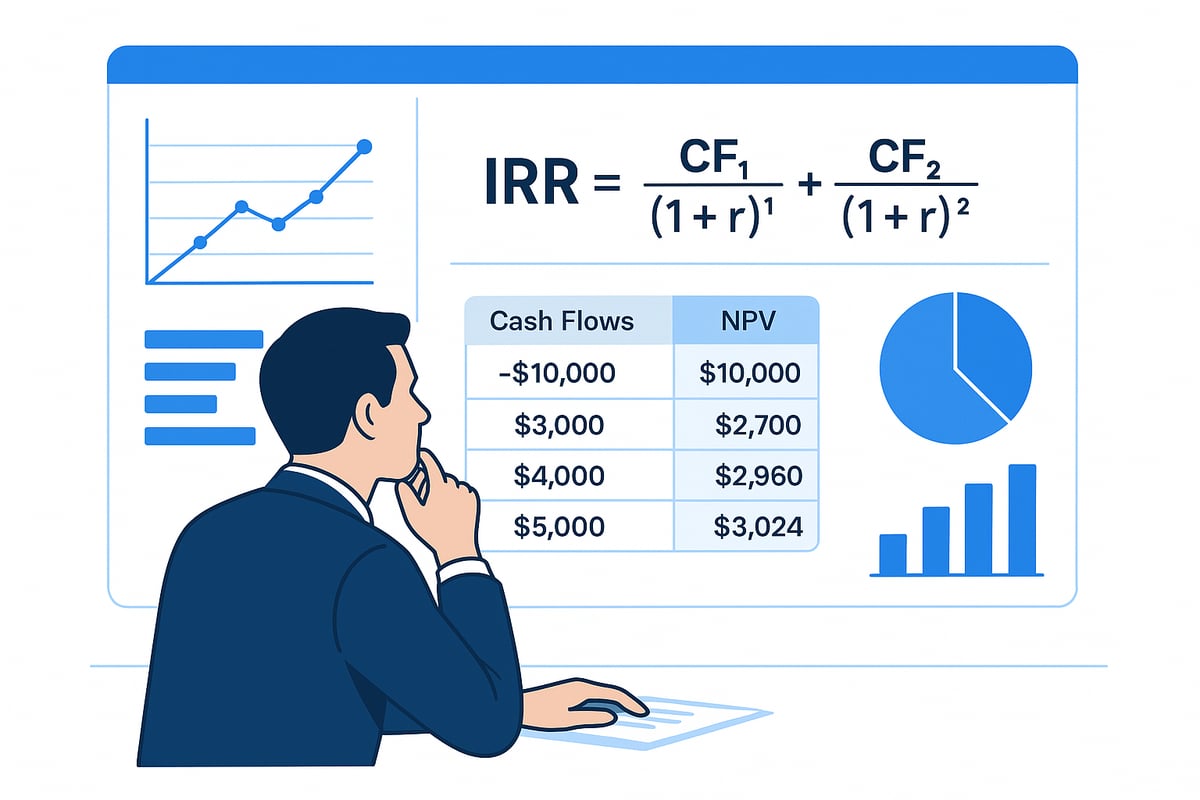
The internal rate of return is a financial metric used to evaluate the profitability of potential investments. Mathematically, it is the discount rate that makes the net present value (NPV) of all cash flows from a project equal to zero. This means the present value of outflows matches the present value of inflows.
Unlike ROI or CAGR, the internal rate of return accounts for the timing of each cash flow, reflecting the time value of money. IRR is central to capital budgeting, helping companies decide whether to proceed with projects. For example, suppose you invest $10,000 today and receive $2,500 per year for five years. The IRR is the rate that sets the NPV of these cash flows to zero. For further foundational insights, see this Internal Rate of Return Overview & Research Examples.
Why IRR Matters for Investors
The internal rate of return is vital for comparing investment opportunities across sectors. Investors use IRR to measure expected returns in private equity, real estate, and business projects. A higher IRR often signals a more attractive investment, but it also reflects underlying risk.
In venture capital, the internal rate of return is a key benchmark for startup evaluation. It enables investors to prioritize projects, balancing profitability and risk. Using IRR, investors can allocate capital to the most promising opportunities, optimizing long-term growth.
Key IRR Terminology Explained
To accurately calculate the internal rate of return, you must understand essential terms:
- Cash flows: The money moving in and out of an investment.
- Discount rate: The rate used to convert future cash flows to present value.
- NPV: Net present value, the sum of discounted cash flows.
- Hurdle rate: The minimum acceptable return for an investment.
A positive internal rate of return means profits exceed costs, while a negative IRR indicates losses. Non-conventional cash flows, with alternating signs, can result in multiple IRRs. For example, a project with an initial investment, followed by gains, then a large expense, may have two IRR solutions.
IRR vs. Other Investment Metrics
While the internal rate of return is powerful, it is not the only metric for investment analysis. Here is how IRR compares:
| Metric | Focus | Pros | Cons |
|---|---|---|---|
| IRR | Annualized return | Considers cash flow timing | Multiple IRRs possible |
| NPV | Absolute value | Direct value addition | Sensitive to discount rate |
| ROI | Overall gain/loss | Simple to calculate | Ignores time value |
| Payback Period | Time to recover | Easy for quick checks | Ignores post-payback gains |
| MIRR | Modified IRR | Realistic reinvestment | More complex to compute |
For instance, in real estate, IRR helps compare two properties with different cash flow patterns, while NPV shows the total value created.
Real-World Statistics and Usage Trends
Today, the internal rate of return is a standard tool for institutional investors. According to Preqin (2023), 76% of institutional investors use IRR as a primary decision metric. Fintech platforms increasingly automate IRR calculations, making analysis accessible to more investors.
The internal rate of return also plays a growing role in ESG and impact investing, guiding capital toward sustainable projects. Recent private equity reports highlight IRR as a key indicator of fund performance, confirming its relevance in dynamic markets.
Step-by-Step Guide: Calculating IRR in 2025
Unlocking the power of internal rate of return starts with understanding each step in the calculation process. In 2025, investors need precision, reliable tools, and a clear methodology to ensure accurate IRR analysis. Follow this guide to master each stage and make informed investment decisions.

Step 1: Gather Accurate Cash Flow Data
Accurate cash flow data is the foundation of any internal rate of return calculation. Start by identifying all expected inflows and outflows for your investment over its lifespan.
Sources for reliable cash flow estimates include:
- Audited company financials
- Projected revenue and expense forecasts
- Historical data from similar investments
Common pitfalls include overestimating revenues or underestimating costs. Ensure each cash flow is realistic and supported by evidence. For example, a five-year project might have the following cash flow table:
| Year | Cash Flow ($) |
|---|---|
| 0 | -100,000 |
| 1 | 20,000 |
| 2 | 30,000 |
| 3 | 30,000 |
| 4 | 40,000 |
| 5 | 50,000 |
Careful data gathering ensures your internal rate of return calculation reflects true investment performance.
Step 2: Set Up the IRR Calculation
Once your cash flows are organized, structure them chronologically. The initial investment is always a negative cash flow, followed by positive or negative amounts each period.
For even cash flows (like annuities), setup is straightforward. For uneven cash flows, list each one by year or period. This setup is crucial for an accurate internal rate of return calculation.
Here is an example investment timeline:
| Period | Cash Flow ($) |
|---|---|
| 0 | -80,000 |
| 1 | 15,000 |
| 2 | 20,000 |
| 3 | 25,000 |
| 4 | 30,000 |
| 5 | 35,000 |
For an in-depth look at how IRR is applied in project investment decisions, see this Application Analysis of IRR in Project Investment.
Step 3: Use Financial Calculators and Software
Modern investors use technology to streamline the internal rate of return calculation. Excel, Google Sheets, and dedicated financial calculators offer quick and accurate results.
To calculate IRR in Excel, use the =IRR(values) formula. List your cash flows in consecutive cells and input the range as the argument. For example:
=IRR(A1:A6)
Online IRR calculators are also available, providing user-friendly interfaces. Manual calculations, while possible, are time-consuming and prone to error.
Digital tools save time and reduce mistakes, making them the preferred method for internal rate of return analysis in 2025.
Step 4: Interpret the IRR Result
After calculation, interpreting the internal rate of return is essential. A higher IRR indicates greater expected profitability, but context matters.
Compare the IRR to your hurdle rate or required rate of return. If the IRR exceeds this benchmark, the investment may be attractive. For example, if a real estate project yields an IRR of 12% and your hurdle rate is 10%, the project is likely worth pursuing.
However, always consider factors such as risk, liquidity, and market conditions. A high internal rate of return does not guarantee success in isolation.
Step 5: Troubleshooting Common IRR Issues
Sometimes, the internal rate of return calculation yields unexpected results. Multiple IRRs can occur with non-traditional cash flows that alternate between positive and negative.
You may also encounter cases where no IRR or a negative IRR appears. This often signals an unprofitable investment or unrealistic assumptions.
To address these issues:
- Check for multiple sign changes in cash flows
- Use Modified IRR (MIRR) for complex scenarios
- Adjust reinvestment assumptions as needed
For example, a project with alternating cash flows may produce two IRR values. Always analyze which IRR is relevant for your investment goals.
Advanced Calculation Techniques for 2025
Sophisticated analysis of internal rate of return is increasingly important. Modified IRR (MIRR) addresses reinvestment rate assumptions, providing a more realistic view of returns.
Multi-phase investments, such as tech startups, require staged IRR calculations to account for varying risk and capital infusions. Artificial intelligence and machine learning are now used to project cash flows and optimize IRR models.
For example, calculating MIRR in a startup involves specifying both the finance rate and reinvestment rate to better reflect true performance. These techniques ensure your internal rate of return assessment stays current with 2025’s evolving investment landscape.
IRR Calculation in Special Asset Classes
The internal rate of return is applied differently across asset classes. In real estate, IRR helps compare rental properties to fix-and-flip investments. Private equity uses IRR to assess fund performance across multiple deals.
Infrastructure and renewable energy projects often involve long-term, staged cash flows, making IRR especially valuable. For example, a solar project’s IRR calculation considers initial construction costs and ongoing revenue from energy sales.
Understanding these nuances ensures your internal rate of return analysis remains accurate and relevant, regardless of asset class.
Practical Applications of IRR for Investors
The internal rate of return is a powerful tool for evaluating diverse investment opportunities. Its flexibility allows investors to compare projects, assess risk, and optimize capital allocation across multiple asset classes. Let’s explore how the internal rate of return is applied in real-world scenarios, making it an indispensable metric in 2025.

Using IRR for Project Comparison
The internal rate of return is essential when investors need to rank and choose between multiple projects. By calculating the IRR for each potential investment, you can directly compare their expected profitability, even if the projects differ in size or duration.
For example, if you are considering two commercial properties, one with a higher IRR may offer better growth potential, while another with a slightly lower IRR but lower risk could be more suitable for conservative goals.
In portfolio optimization, investors often build tables to compare IRR values across various assets. This approach helps prioritize projects that align with strategic objectives and risk tolerance.
IRR in Private Equity and Venture Capital
In private equity and venture capital, the internal rate of return serves as a benchmark for fund managers and investors. It helps measure fund performance over time, accounting for irregular cash flows and investment exits.
Typical IRR ranges for private equity deals are between 15 and 25 percent, although higher figures may be seen in successful venture capital exits. For instance, a Series A investment in a growing tech startup might project an IRR of 30 percent, indicating significant upside if milestones are achieved.
Fund managers use IRR to communicate performance to stakeholders and to compare new opportunities in a competitive market.
IRR in Real Estate Investing
Real estate investors rely on the internal rate of return to evaluate both buy-and-hold and development projects. By modeling all future cash inflows from rents and the final sale, alongside the initial investment, IRR reveals the long-term profitability of a property.
For a multifamily building, for instance, investors estimate annual rental income, subtract expenses, and project a sale price after several years. Calculating the IRR for this cash flow stream helps determine if the investment meets required returns.
IRR also enables direct comparison between rental yields and development opportunities within a property portfolio.
IRR in Fixed Income and Bonds
In the fixed income space, the internal rate of return is synonymous with yield to maturity (YTM) for bonds. This metric allows investors to assess the true annualized return of a bond, considering all coupon payments and the maturity value.
Understanding the concept of maturity date in finance is vital, as the timing of cash flows directly affects the IRR calculation. For example, when constructing a bond ladder, investors use IRR to compare bonds with different maturities and coupon structures, optimizing for both income and capital preservation.
Structured products and loan portfolios also benefit from IRR analysis, guiding portfolio allocation.
IRR in Corporate Finance and Capital Budgeting
Corporations regularly apply the internal rate of return when evaluating new product launches, facility upgrades, or expansion projects. By comparing the IRR of a proposal against the company’s hurdle rate, decision-makers can determine if the project is likely to create value.
For example, a factory upgrade might require a significant upfront investment, with projected cost savings and increased revenue over several years. If the IRR exceeds the company’s required return, the project is typically approved.
This disciplined approach ensures capital is allocated to initiatives with the highest potential for growth.
Case Studies: Successful IRR-Driven Decisions
Numerous investment successes have been attributed to the effective use of the internal rate of return. For instance, in recent M&A deals, companies have relied on IRR analysis to validate acquisition targets and forecast long-term value creation.
Lessons from both high and low IRR projects highlight the importance of realistic cash flow assumptions and thorough due diligence. In private equity, funds with consistently strong IRR track records attract more capital, reinforcing the metric’s influence.
These case studies demonstrate how mastering IRR leads to smarter, more profitable investment decisions.
Limitations and Pitfalls of Relying on IRR
Understanding the limitations of the internal rate of return is essential for making informed investment decisions. While the internal rate of return can be a powerful tool, relying on it exclusively may lead to errors or missed opportunities. Let us break down the most common pitfalls investors face when using this metric.
Common Misconceptions About IRR
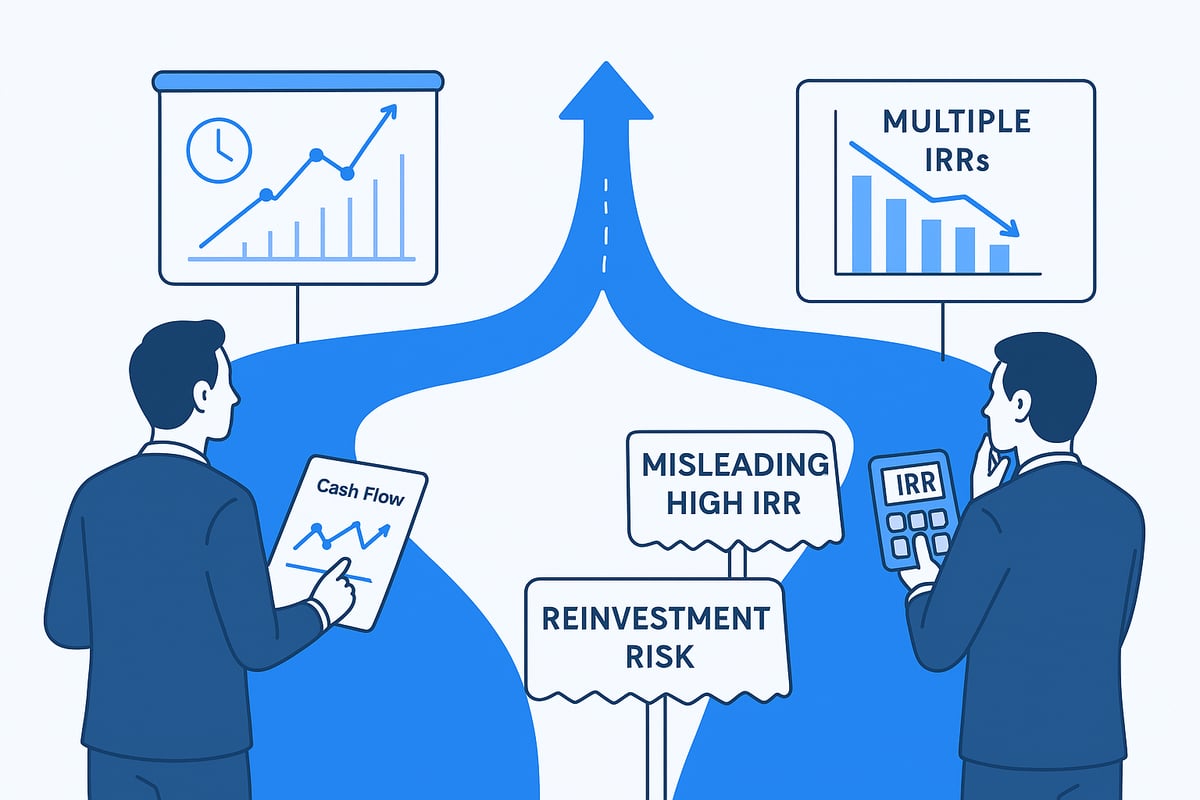
Many investors mistakenly view the internal rate of return as a catch-all measure of investment quality. However, IRR does not consider the absolute size of a project. A small project might show a high internal rate of return but generate limited overall profit. This can be misleading if you only focus on percentage returns and ignore the dollar value.
Another misconception is that a high IRR always means a better investment. Short-term projects with quick paybacks can inflate the internal rate of return, overshadowing larger, longer-term opportunities that may be more profitable in total. For example, a $10,000 project with a 40% IRR may yield less money than a $1,000,000 project with a 15% IRR.
Multiple IRRs and Non-Conventional Cash Flows
The internal rate of return assumes a standard pattern of cash flows: an initial outlay followed by positive returns. If a project has alternating positive and negative cash flows, it can produce multiple IRRs, confusing the decision-making process. This often occurs in infrastructure or energy investments with significant future upgrades or decommissioning costs.
To resolve this, investors often use the Modified IRR (MIRR), which provides a unique solution by adjusting for reinvestment rates. For complex projects like public-private partnerships, it is worth reviewing Is It Correct to Use IRR in PPP Projects? for in-depth analysis of IRR's appropriateness in these scenarios.
Reinvestment Rate Assumptions
The internal rate of return calculation assumes that interim cash flows are reinvested at the same rate as the IRR itself. In reality, finding opportunities to reinvest at such a high rate is rare, especially in volatile markets. This can lead to overstated returns and unrealistic expectations.
To address this, investors may use the Modified IRR, which assumes reinvestment at a more conservative rate, such as the firm’s cost of capital or a benchmark return. Comparing IRR and MIRR results can highlight the impact of reinvestment assumptions and provide a clearer picture of expected performance.
IRR vs. Actual Investor Experience
Real-world investments rarely follow the projections used in internal rate of return calculations. Delays, cost overruns, and market shifts can reduce actual returns compared to projected IRR. For instance, a real estate project might forecast a 20% IRR, but unexpected regulatory changes or construction delays could cut returns significantly.
It is crucial to review past projects and compare projected internal rate of return against actual outcomes. This helps investors refine their forecasting process and identify hidden risks that may not be captured by IRR alone.
When Not to Use IRR
The internal rate of return is not suitable for every situation. It is less effective when comparing mutually exclusive projects of different sizes, as it ignores the scale of investment. For example, choosing between a $1 million and a $10 million project based solely on IRR could lead to suboptimal capital allocation.
IRR also struggles with investments that have highly unpredictable or irregular cash flows. In such cases, metrics like Net Present Value (NPV) or Payback Period may provide better guidance. For projects involving significant capital expenditure, evaluating absolute returns alongside IRR helps ensure you are making the most impactful investment decisions.
Expert Tips and Best Practices for Maximizing IRR in 2025
Maximizing your internal rate of return requires more than just running numbers. In 2025's fast-evolving investment landscape, a disciplined approach, robust analysis, and smart use of technology are essential. Below, discover expert insights and actionable strategies to ensure your internal rate of return consistently works in your favor.
Setting Realistic Hurdle Rates
Defining the right hurdle rate is the foundation for any successful internal rate of return analysis. In 2025, market volatility and inflation mean investors must regularly update their benchmarks.
Begin by researching industry averages and economic forecasts. Consider inflation trends, interest rates, and sector-specific risks. For example, private equity firms may set higher hurdle rates than real estate investors. Use a simple table to compare typical hurdle rates:
| Asset Class | 2025 Hurdle Rate (%) |
|---|---|
| Private Equity | 12 – 20 |
| Real Estate | 8 – 15 |
| Infrastructure | 6 – 10 |
Adjust your internal rate of return expectations according to your risk appetite and project characteristics. A thoughtful hurdle rate ensures you only pursue investments that truly add value.
Stress Testing and Scenario Analysis
Stress testing your internal rate of return projections is vital for risk management. By modeling best, base, and worst-case scenarios, you uncover how sensitive your IRR is to changes in key variables.
Use spreadsheet tools to vary assumptions like revenue growth, exit timing, or capital expenditures. For example:
# Example: IRR sensitivity to revenue growth
for growth_rate in [0.02, 0.05, 0.08]:
    irr = calculate_irr(cash_flows, growth_rate)
    print(f"IRR at {growth_rate*100}% growth: {irr}")
Run multiple scenarios to see how your internal rate of return fluctuates. This process builds confidence in your decision-making and helps you prepare for unexpected outcomes.
Integrating IRR with Other Metrics
Relying solely on the internal rate of return can be misleading. Savvy investors combine IRR with other key metrics like NPV, payback period, and ROI for a holistic view.
For example, while IRR highlights efficiency, NPV shows absolute value creation. The payback period reveals liquidity risk, and ROI offers a straightforward profitability snapshot. You can also consider what is residual income as a complementary measure, especially when evaluating ongoing business projects.
Building a dashboard that tracks multiple metrics ensures your investment decisions are well-rounded and resilient to single-metric bias.
Avoiding IRR Manipulation and Bias
Internal rate of return calculations are susceptible to manipulation, especially when cash flow assumptions are overly optimistic or when exit values are inflated.
To maintain integrity, always audit your IRR models. Cross-check cash flows, verify input data, and request independent reviews for complex deals. Be wary of marketing materials that boast unusually high IRRs without transparent documentation.
Common red flags include:
- Excluding upfront costs
- Assuming unrealistic reinvestment rates
- Ignoring interim cash distributions
A disciplined approach protects you from making costly decisions based on skewed internal rate of return figures.
Leveraging Technology for IRR Analysis
Technology now plays a pivotal role in enhancing internal rate of return analysis. AI-powered forecasting tools and cloud-based platforms automate complex modeling, reduce manual errors, and deliver real-time insights.
Adopt software that integrates with your existing systems, offering scenario planning, data visualization, and collaborative features. Automation allows you to test more variables, update assumptions instantly, and share results across teams.
The right tech stack not only streamlines internal rate of return calculations but also elevates the overall quality of your investment process.
Staying Ahead: IRR Trends for 2025 and Beyond
To sustain high internal rate of return outcomes, stay alert to emerging trends. Rising interest rates and inflation may compress returns, while ESG and digital assets are reshaping investment criteria.
Many institutions are also examining the internal rates of return for public R&D, reflecting a shift toward innovation-driven projects. Expect increased use of IRR in evaluating sustainability and technology investments.
By adapting your internal rate of return strategy to these trends, you position yourself to capture new opportunities and mitigate future risks.
As you’ve seen throughout this guide, mastering Internal Rate of Return equips you to evaluate investments with clarity, compare opportunities, and make decisions grounded in historical context. At Historic Financial News, we believe that understanding the past is key to navigating today’s evolving markets. If you’re passionate about learning from financial history and want to shape how investors, students, and analysts explore market trends, we invite you to Join Our Beta.
Experience our interactive platform firsthand and help us build a smarter, more insightful way to uncover the stories behind every return.